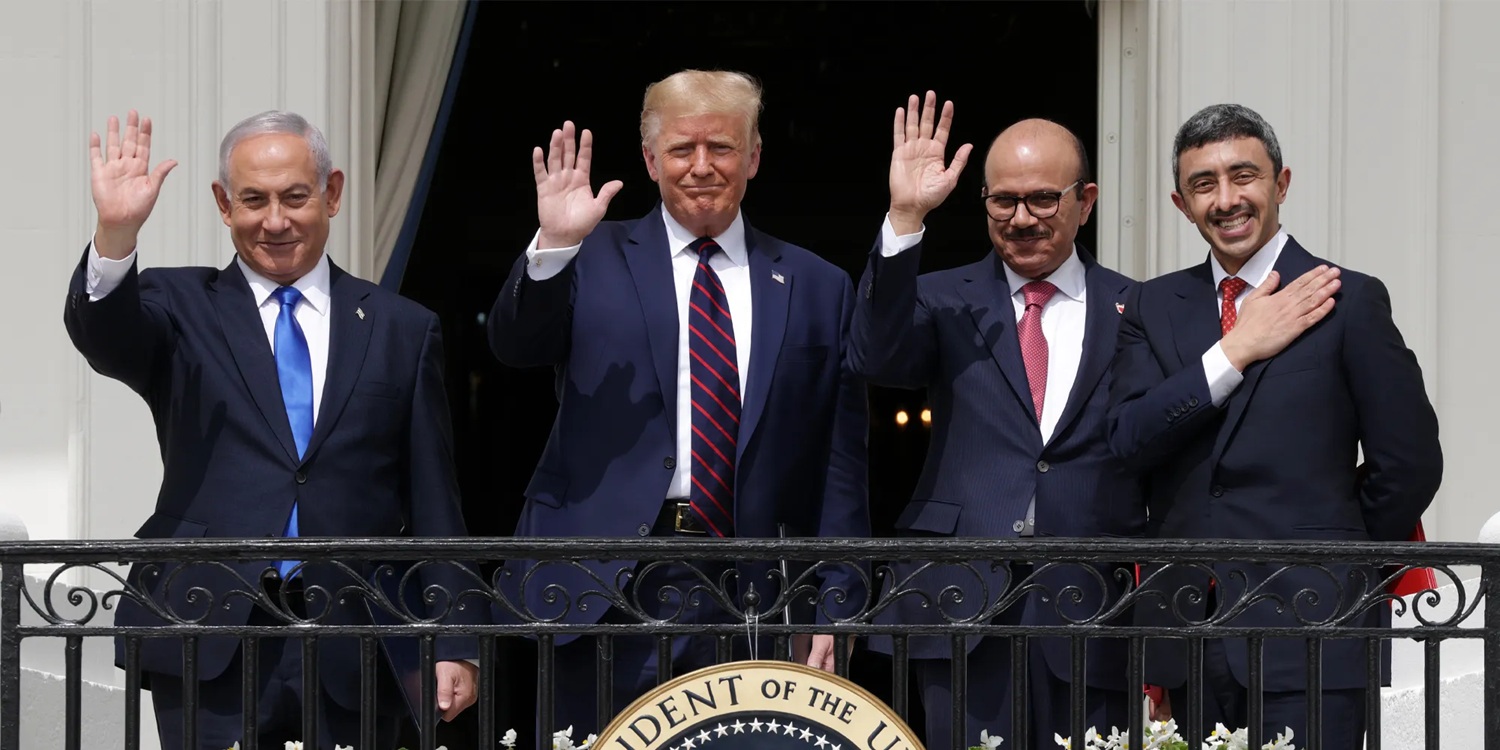
A strange irony underlies the enthusiasm surrounding the Abraham Accords. For Israel, they represent one of the most important diplomatic breakthroughs in its modern history. For the American and Israeli right, they proved that peace did not have to be purchased through territorial retreat or through the weakening of Jewish sovereignty. Arab states could recognise Israel, establish relations with Jerusalem and enter strategic and economic cooperation without Israel first being required to surrender the principles on which its security depended.
By Rami Audi
The Abraham Accords demonstrated that another path was possible. Yet precisely because the Accords may prove so successful, a question deserves to be asked before the celebration becomes history: what kind of political order are they ultimately creating, and what happens to Zion when that order becomes larger than the state that gave birth to it?
The question may sound provocative because Abraham is associated with reconciliation, fraternity and peace, while Zion is associated with Jewish sovereignty and particularity. But that is precisely why the distinction matters. Abraham is not Zion.
Abraham represents a common ancestry shared by peoples who subsequently became distinct religious and political communities. Zion represents something much more specific: the return of the Jewish people to a homeland and the recovery of sovereignty after centuries when Jews possessed a civilisation but not the political power to determine their own fate.
The two ideas can coexist. They should coexist. But they should not be confused.
Israel did not emerge from history simply because Jews wanted somewhere safe to live. The deeper Zionist revolution was the transformation of the Jew from an object of history into an actor in history. For two thousand years, Jewish communities survived under others' sovereignty. They preserved their faith, their laws, their language, their memory and their sense of peoplehood.
Still, they lacked the political power to shape the larger circumstances of their existence. Zionism was the answer to that condition. It insisted that Jewish survival required not only cultural continuity but political sovereignty.
This is why the Abrahamic idea deserves more serious consideration than either its admirers or its critics have sometimes given it. It is not merely a diplomatic vocabulary. It contains the possibility of a new regional identity: Jews and Arabs no longer defining one another primarily through conflict, but through a shared Abrahamic ancestry and an expanding network of economic, political and cultural relationships.
That possibility feels genuinely historic. After all, the Middle East has suffered enough from the conviction that difference requires permanent hostility.
But every successful universal idea eventually confronts the particular identities that live inside it. The question is not whether Jews and Arabs should cooperate. They should. The question is whether the political framework created by that cooperation will merely connect distinct identities or gradually redefine them.
Europe offers a useful warning because it has spent generations wrestling with precisely this problem. The European project began with an admirable ambition: nations that had fought catastrophic wars should become sufficiently interconnected that war between them would become increasingly unthinkable. It succeeded to a remarkable degree. Yet the more Europe integrated, the more difficult a different question became: what exactly is Europe?
Is Europe simply a market and a legal order? Is it a political project? Is it a collection of sovereign nations? Is it a civilisation shaped by centuries of Christianity, classical culture and European history? Or can it continually expand its definition without changing the meaning of the civilisation itself?
The debate over Turkey's possible place within Europe exposed this tension particularly clearly. The argument was never simply about geography or economics. Turkey's relationship with Europe forced Europeans to confront the difference between participating in a political system and belonging to the civilisation that system historically represented.
One could support closer relations with Turkey and still ask whether incorporating a very different demographic, religious, and historical weight would eventually alter Europe's self-understanding.
That question is relevant to Israel for a reason that is easy to miss. Integration is never merely about adding relationships. Over time, it changes the environment in which identities exist. The institutions become shared, economic interests become intertwined, younger generations grow up with fewer psychological borders than their parents, and eventually the distinction between the original political communities can begin to look less important than the larger framework that contains them.
Europe's experience does not prove that integration inevitably destroys identity. It proves something more modest and more important: integration affects identity.
Israel should therefore enter the Abrahamic age with confidence, but not with innocence.
The Abraham Accords could make Israel safer. They could make it richer. They could create strategic relationships that previous generations could scarcely have imagined. They could give Arab governments a direct interest in Israel's stability and transform old enemies into partners. All of this should be welcomed.
But peace is not politically neutral.
The generations that signed the Accords will not be the generations that live with their full consequences. Today's agreements will eventually become tomorrow's institutions, and tomorrow's institutions will shape the imagination of people who may no longer remember how extraordinary the first handshake was.
That is where demography enters the discussion, not as a weapon against Arabs or Muslims, and certainly not as an argument that coexistence is impossible, but as one of the oldest realities in political history: populations matter. Numbers matter. Generations matter. The political meaning of a state is influenced by who lives within it, who participates in its institutions and which narratives become dominant over time.
A country can retain its borders while its conception of itself changes.
It can retain its flag, its parliament and its army while the historical meaning attached to them becomes less certain.
Israel therefore has to ask a question that Europe has struggled with for decades: can a political community become part of a much larger civilisation without eventually allowing that larger civilisation to redefine the reason for its own existence?
The danger, if there is one, is not that the Abraham Accords will suddenly abolish Zionism. Nothing so dramatic is required. A single decision rarely destroys historical identities. They are more often diluted through a thousand decisions that each appear reasonable on their own.
A new agreement here. A new institution there. A common regional framework. Shared educational programs. Integrated markets. Cultural initiatives. A new political vocabulary in which the differences between communities become less important than their common Abrahamic inheritance.
None of these things is necessarily bad. Indeed, many are desirable.
But taken together over generations, they could produce a Middle Eastern political identity in which Zion becomes one component of a larger Abrahamic story rather than the organising principle of the Jewish state.
That is the possibility Israel should consider now, while the Abrahamic project is still young enough to be shaped.
There is a profound difference between building an Abrahamic Middle East around a sovereign Jewish Israel and building an Abrahamic Middle East in which Israel's Jewish particularity gradually becomes merely one identity among several.
The first strengthens Zion through peace. The second could eventually dilute Zion through peace.
That is why the European comparison matters. Europe did not lose its identity because somebody declared that European identity was abolished. The question of identity became complicated because the political structure grew larger than the historical nations that created it. The same process need not happen in Israel, but we should not dismiss the possibility simply because the intentions behind the Abraham Accords are positive.
Another reason to be cautious is this. Universal political projects are often most attractive when they promise to end past divisions. They speak the language of reconciliation because reconciliation is morally compelling.
But every universal project tempts us to assume that the best way to overcome conflict is to make the particular identities that produced it less significant. That may work in some circumstances. It can also become a form of historical amnesia.
The Jewish people did not survive two thousand years of dispersion by forgetting who they were. They survived by remembering. The restoration of sovereignty was therefore not a rejection of humanity's universal brotherhood; it was the recovery of a particular people's right to exist as itself.
There is no reason that an Arab should become less Arab for an Israeli to remain Jewish. There is no reason that a Muslim should become less Muslim for Jewish sovereignty to be respected. And Abrahamic cooperation should not require Zion to become something other than Zion.
In fact, that may be the only basis upon which the Abrahamic vision can succeed without becoming another utopian project. Peace should not require sameness. It should make difference safe.
That principle ought to guide Israel's relationship with the new Middle East. Israel should embrace the Accords, deepen them and extend them. It should welcome Arab recognition and build economic and strategic relationships that bind the region together. It should encourage a Middle East in which Jewish and Arab children inherit partnership rather than inherited hostility.
But Israel should also insist on something nonnegotiable: Jewish sovereignty is not meant to disappear into a larger political identity once that identity becomes friendly.
The Jewish state does not need to choose between Zion and Abraham. It needs to know the difference between them. Abraham can be the bridge. Zion must remain the home.
That distinction matters even more because the greatest transformations in history often happen without anyone intending them. Political structures acquire their own momentum. Ideas travel beyond their founders' intentions. Institutions created for one purpose eventually serve another. A generation establishes a framework; another generation gives that framework a meaning the founders never anticipated.
The architects of the Abraham Accords cannot know what the Middle East will look like fifty years from now. Neither can we. But they can understand the principle that should govern the uncertainty: peace should enlarge Israel's freedom to be itself, not make its particular identity increasingly negotiable.
This is ultimately why Abraham is not Zion. Abraham is the possibility that the descendants of different peoples can meet again. Zion answers what happens when one of those peoples has spent centuries without a sovereign home. Abraham can bring the region together. Zion reminds Israel why it needed sovereignty in the first place. The two should meet in friendship, not in substitution.
Perhaps that is the great opportunity hidden inside Israel's greatest peace. The Abraham Accords could become the foundation of a Middle East in which the Jewish state no longer has to live permanently on the defensive, surrounded by enemies and haunted by the possibility of annihilation. If that happens, it would be one of the great achievements of modern Jewish history.
But precisely because peace may succeed, Israel must think beyond the first generation of peace. The old Jewish fear was that the nations would never accept the Jew.
The new possibility is more subtle: that the nations may finally accept the Jew so completely within a larger Abrahamic framework that the particular historical meaning of Jewish sovereignty slowly becomes unnecessary in the minds of those who inherit it.
That would not be a military defeat. It would not be an invasion. It would not even require hostility. It would be something quieter: the gradual replacement of a particular identity by a larger one. And that is why Israel should enter Abraham's world with open arms, but with its memory intact.
The Abrahamic Accords can surround Zion with friends. They must never make Zion forget why it exists.