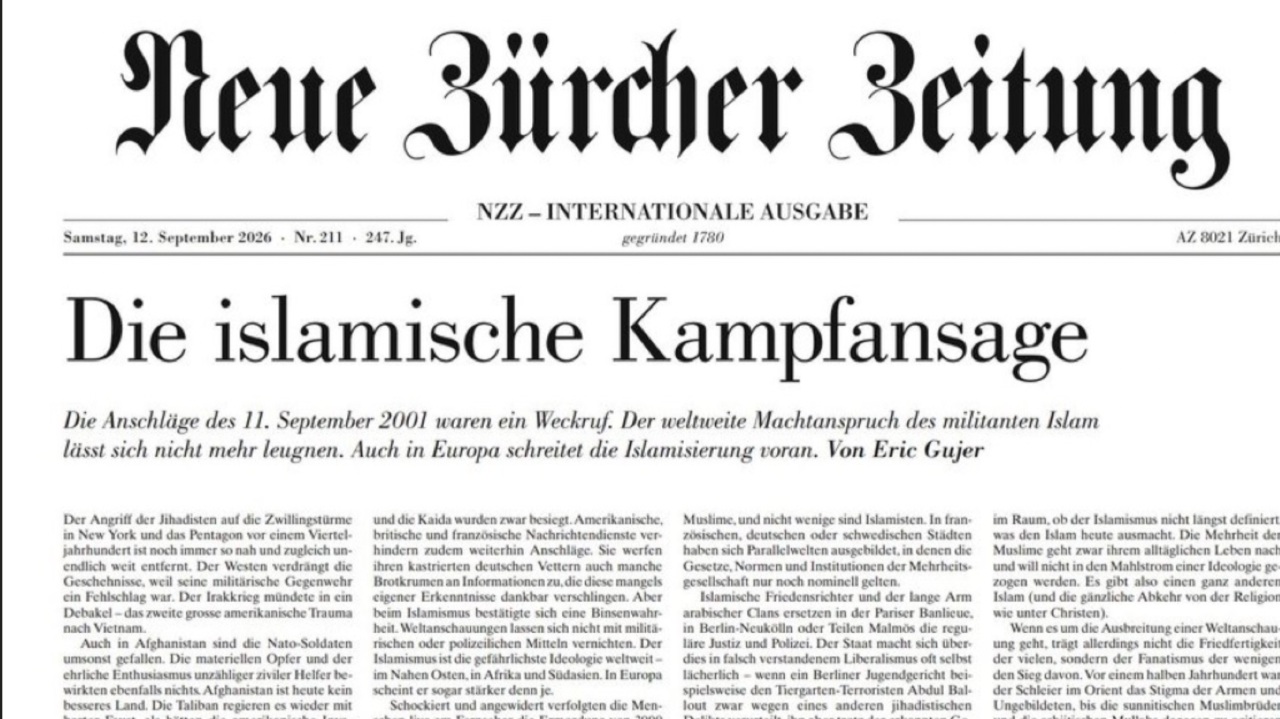
The attacks of September 11, 2001, served as a wake-up call. Militant Islam’s claim to global power can no longer be denied. Islamisation is advancing in Europe, too.
The jihadist attack on the Twin Towers in New York and the Pentagon, a quarter of a century ago, feels both immediate and infinitely distant. The West suppresses the memory of what happened because its military counter-offensive failed. The war in Iraq concluded in a debacle, America’s second major trauma after Vietnam.
NATO soldiers also died in vain in Afghanistan. The material sacrifices and genuine enthusiasm of countless civilian aid workers achieved nothing either; Afghanistan is no better off today. The Taliban once again rule with an iron fist, as if the American invasion and two decades of Western presence had never occurred.
An iron law prevails in the Hindu Kush: foreign conquerors come and go, defeated or, as seen in the final withdrawal of 2021, disillusioned. The mountains and Pashtunwali, the Pashtuns’ ancient code of honour, prove stronger.
The historical anomaly
The event marked by the emblematic date "9/11" also seems so distant because the geopolitical landscape has fundamentally changed. It is no longer a terrorist mastermind like Osama bin Laden who threatens world peace, but rather the traditional rivals of the great powers.
Al-Qaeda rose to such prominence only because of an anomaly: the historical interlude following the fall of the Berlin Wall and the collapse of the Soviet Union, when the United States briefly reigned as the global hegemon. China and Russia ended that era. And yet, September 11 remains present in an almost ominous way.
Violent Islamism, which had been roiling the Middle East since the 1979 Shiite revolution in Iran and the 1981 assassination of Egyptian President Anwar al-Sadat, burst into the Western consciousness with full force on that September day. It has never left it since.
While the bloodthirsty caliphates of the Islamic State and Al-Qaeda were indeed defeated, and American, British, and French intelligence agencies have prevented further attacks, they occasionally toss a few scraps of information to their neutered German counterparts, scraps the latter gratefully devour, lacking intelligence of their own.
Yet, regarding Islamism, a simple truth was confirmed: worldviews cannot be destroyed by military or police means. Islamism is the most dangerous ideology worldwide, in the Middle East, Africa, and South Asia. In Europe, it even appears stronger than ever.
Shocked and horrified, people watched live on television as 3,000 innocent people were murdered in the United States. For the first time in its history, NATO invoked its collective defence clause. German Chancellor Schröder pledged "unconditional solidarity."
The atrocities committed by Hamas on October 7, 2023, also triggered a wave of sympathy for the Palestinian perpetrators, not for the 1,200 Israeli victims. Scaled to the size of the US population, that figure would equate to more than 40,000 deaths, nearly four-fifths of the number of Americans killed in Vietnam.
How would America have reacted had it been struck by an attack of that magnitude? One must keep that ratio in mind when assessing Israel's conduct of the war in the Gaza Strip and Lebanon.
In New York, antisemites are hijacking the Democratic Party. In Berlin, supporters of Die Linke, a party partly officially designated as antisemitic, dance exuberantly to a rap song calling for the killing of Israeli soldiers. Western sympathisers lose themselves in bizarre "anti-colonial" and "anti-racist" theories, thereby, consciously or unconsciously, turning themselves into "useful idiots" for Islamism.
The invasion by Hamas and Hezbollah, the ruthless Israeli counter-offensive in the Gaza Strip, and the conflicts involving Lebanon and Iran act as accelerants for a dehumanising ideology.
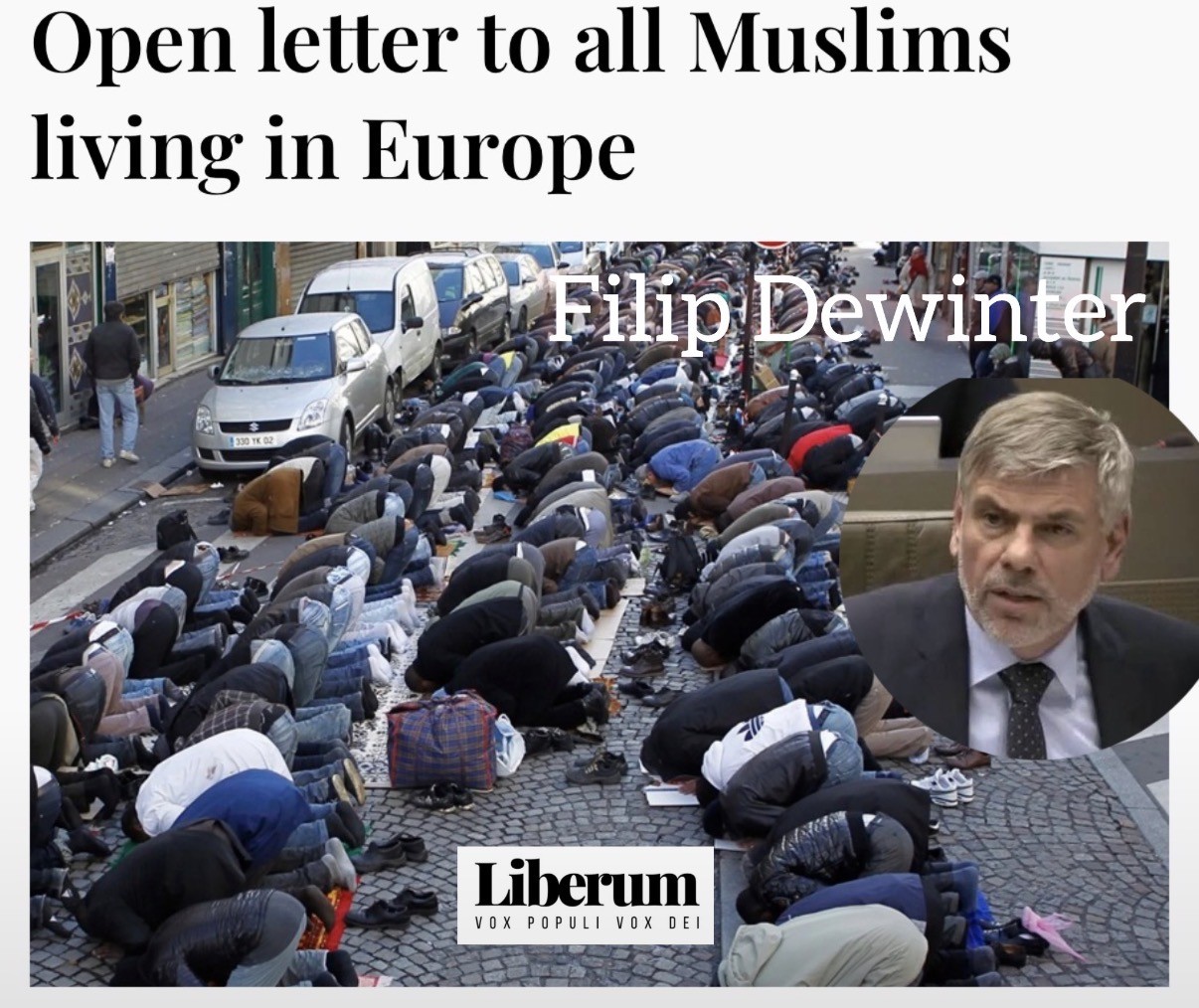
That is one reason for the dominance of Islamism in Europe. The other is uncontrolled immigration. Since the middle of the last decade, a massive wave of economic migrants and asylum seekers has been pouring into Europe.
Many of them are Muslim, and a significant number are Islamists. In French, German, English, and Swedish cities, parallel societies have emerged where the laws, norms, and institutions of the majority society apply in name only.
Islamic arbitrators and the long arm of Arab clans are supplanting the regular justice system and police in the Parisian banlieues, in Berlin-Neukölln, and in parts of Malmö. Moreover, the state often makes a mockery of itself through a misguided form of liberalism, for instance, when a Berlin juvenile court judge convicts a jihadist deemed dangerous of a jihad-related offence, yet sets him free nonetheless.
Militant Islamist organisations gain state recognition by receiving subsidies or having their representatives appointed to official bodies. The inability, or political unwillingness, of the majority society to defend its own way of life is leading to a creeping Islamisation.
In France, where this process is most advanced, a distinct political genre has emerged from this trend. It predicts the West's downfall; the story usually ends with an Islamist president seizing power. Just how absurd that sounds depends on which neighbourhood of Paris or Marseille one happens to be in.
Silent Indoctrination
To this day, many who advocate for peaceful coexistence with Muslims make a careful distinction between Islam and Islamism. After all, the scriptures of all three Abrahamic religions contain passages calling for the exclusion of those of other faiths, or worse.
In that regard, Christianity was no different from Islam in establishing earthly empires through fire, sword, and Holy Scripture.
Yet, while Christianity in Europe, plagued by guilt complexes, slowly withers into what may well be a permanent, residual form, political Islam appears unstoppable. This raises the question of whether Islamism has now come to define what Islam actually entails today.
While the majority of Muslims go about their daily lives and have no desire to be swept up in the maelstrom of an ideology, a very different kind of Islam certainly exists—as does a complete rejection of religion, just as one finds among Christians. Yet when it comes to spreading a worldview, it is not the peacefulness of the many but the fanaticism of the few that ultimately triumphs.
Half a century ago, the veil in the East was a mark of poverty and a lack of education, until the Sunni Muslim Brotherhood and the Shiite mullahs began to campaign against this. Today, Islamists shape public life; in Iran, they even seized power.
Fundamentalist observance of Islam is spreading in Europe as well. What role does moderate Islam actually play anymore? There is hardly any talk left of a "Euro-Islam", moderate and possessing a specifically European identity. Schoolyards and classrooms have become battlegrounds, for there is no parallel world there, only a forced coexistence.
When Muhammad is spoken of differently than Christ, when girls are absent from PE lessons or school trips, when the school cafeteria menu becomes a diplomatic balancing act, secular society capitulates inch by inch. Elsewhere, people can avoid one another; at school, they cannot. This is what remains of the lofty multicultural ideal: tacit segregation.
This separation suits the fundamentalists well, for they have a clear goal and the patience to pursue it. They seek control over Muslims, and to achieve this, they increasingly push back against the majority society and its values.
As a result, the enclaves where Islamism has long since come to define Islam are steadily expanding. The situation is no longer so far removed from the doomsday scenarios facing France.
That is another reason why 9/11 still feels so immediate. The anniversary reminds us of how militant ideologies strive for power: through open violence and subversion, but above all through strategic persistence.