America and Israel may have killed the samurai. They did not kill the sword.
At one point, it seemed the walls of Tehran were about to come tumbling down. The Supreme Leader was dead. Iran's senior military command had been decapitated. Israel had demonstrated an extraordinary ability to penetrate Iranian airspace and strike deep inside the Islamic Republic. Then the United States entered the war with overwhelming force. Surely, this time, the Islamic Republic had reached its end. But Jericho did not fall. The biblical city did not surrender simply because the trumpets sounded, and Tehran did not collapse simply because the last samurai were killed. That may be the war's most important lesson.
By Nadia Ahmad
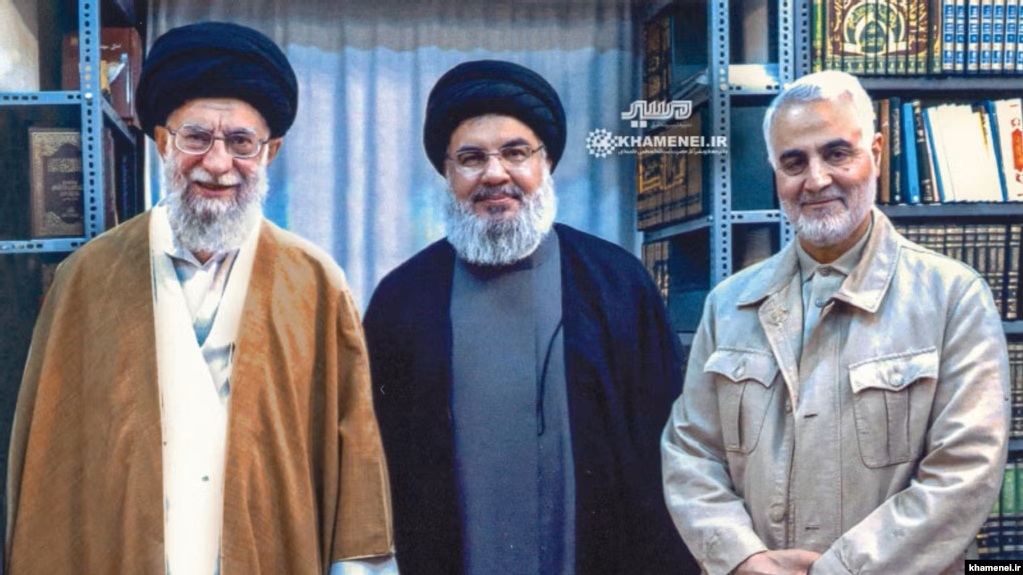
When Ayatollah Ali Khamenei was killed in the opening U.S.-Israeli strikes on February 28, it was tempting to see his death as the final act of the Islamic Republic. For more than three decades, Khamenei had embodied its revolutionary ideology, its confrontation with America and Israel and its vast network of armed allies across the Middle East. Yet the system produced another Khamenei.
His son, Mojtaba, succeeded him as Supreme Leader. The symbolism was almost too perfect. The old samurai had fallen, but the sword had been passed to another hand. The Iranian system had demonstrated that its survival did not depend upon the survival of one man.
And that brings us back to Hassan Nasrallah. Long before Khamenei fell, Israel had already demonstrated the extraordinary power of decapitation. But Nasrallah's story cannot be separated from October 7.
When Hamas launched its assault on Israel on October 7, 2023, Hezbollah opened its own front the following day under Nasrallah's leadership, bringing the Iranian-backed war against Israel into Lebanon and turning the conflict into a wider regional confrontation.
For Israel, October 7 had shattered whatever remained of the assumption that Iran's proxy armies could be contained indefinitely. A threat that could cross the border today could become another October 7 tomorrow. The Israeli calculation changed accordingly.
Nasrallah was killed on September 27, 2024, in an Israeli strike on Hezbollah's central headquarters in Beirut. His death was a dramatic demonstration that Israel could reach the highest levels of an organisation that had spent decades building its military infrastructure beneath the surface of Lebanese society.
Yet Hezbollah did not disappear. Naim Qassem succeeded Nasrallah, and the organisation survived the loss of its most famous leader. But something else had changed. Hezbollah had not merely lost its leader. It had entered a strategic environment far more hostile than the one Nasrallah had inherited.
This is where the story becomes larger than one assassination. Hamas and Hezbollah understood how to ignite a battlefield. They were far less successful at calculating what the fire might consume. Hamas's October 7 gamble brought an overwhelming Israeli response, while Hezbollah's decision to open the northern front on October 8 turned Lebanon into another battlefield.
In doing so, the two organisations helped accelerate the destruction of the regional architecture on which much of their power depended. For years, the road from Tehran to Beirut ran through Damascus. Weapons, money, commanders and supplies moved through Syria, while the Assad regime provided Iran and Hezbollah with a crucial strategic bridge. Then the bridge collapsed.
The fall of Bashar al-Assad's regime was therefore more than the disappearance of another Middle Eastern government. It removed one of the pillars supporting Iran's regional network and left Hezbollah facing a very different Syria on its doorstep. The irony is difficult to miss.
In trying to stretch Israel across multiple fronts, Iran's proxies helped create a war that ultimately weakened the very regional structure that had protected and supplied them. The arsonists had forgotten that fire does not ask who built the house.
Perhaps that is the deeper lesson of Nasrallah's death. He was never the entire Hezbollah system, just as Khamenei was never the entire Iranian system. The power of Iran's revolutionary project resides in the machinery beneath its leaders: the Islamic Revolutionary Guard Corps, the missile and drone industries, the intelligence apparatus, the ideological institutions, the underground military infrastructure and the regional networks built over decades.
A regime can lose its supreme leader and remain a regime. An organisation can lose its founder and remain an organisation. A military can lose its commanders and still possess factories, laboratories, engineers, weapons, underground facilities and the institutional memory of how to fight.
Iran had all of those things. And it had something else: Russia and China.
Neither Moscow nor Beijing needs to send an army to rescue Tehran. Their interests are more sophisticated. Russia can offer battlefield knowledge accumulated through years of war in Ukraine. China can provide technology, industrial capacity and economic channels. Iran supplies the geography, the military infrastructure and the willingness to absorb punishment. The sword can be reforged.
But reforging a sword takes time, and Tehran needs time. Every American missile fired at Iran is a missile that cannot be fired somewhere else. Every carrier group tied to the Middle East is a carrier group unavailable elsewhere.
Every precision weapon consumed in a prolonged campaign must eventually be replaced. Wars are measured not only by territory captured or commanders eliminated, but by what each side must spend to keep fighting.
This is where the shadow of Ukraine enters the story. Russia went into Ukraine expecting a war that would be decided quickly. Instead, Moscow found itself locked into a grinding conflict in which the battlefield continually adapted. Russia learned. Ukraine learned. Weapons evolved. Tactics evolved. The war became a laboratory. Could Iran become America's Ukraine?
The comparison is not literal. Iran is not Ukraine, America is not Russia, and the geography and politics are radically different. The trap, however, can be similar: a supposedly decisive intervention can become a prolonged strategic commitment, consuming weapons, money, intelligence and political attention while giving an adversary time to adapt.
And the longer such a conflict lasts, the more valuable it becomes to America's rivals. Iran does not need to defeat America conventionally to turn survival into a strategic problem. It merely needs to survive long enough to rebuild. Survival gives Tehran time. Time allows it to repair its military architecture, disperse what remains, learn from the blows it has absorbed and seek new ways of protecting the sword.
The question, then, is not whether Moscow or Beijing will fight America's war for Iran. They do not need to. Russia can provide battlefield knowledge accumulated through years of war in Ukraine. China can provide technology, industrial capacity and economic channels. Iran supplies the geography, the military infrastructure and the willingness to absorb punishment.
The sword can be reforged. But reforging a sword is different from restoring the hand that once wielded it. Iran's regional position is not what it was before October 7.
This is why the American-Iranian memorandum matters. The June agreement created a framework to end the fighting and begin negotiations, including a 60-day pause and provisions involving the Strait of Hormuz and sanctions relief. But the agreement subsequently collapsed, and by August the two sides were again accusing each other of violating its terms. Diplomatically, a pause may have been entirely logical. Strategically, every pause in a war creates another question: what does the enemy do with the time?
If Tehran uses that time to restore missile production, reorganise its command structure, repair military infrastructure and deepen cooperation with Russia and China, then the pause is not merely a diplomatic interval. It is a military resource.
That possibility is precisely why Israel's experience matters. For Jerusalem, Iran has never been merely another hostile government. Its nuclear ambitions, ballistic missiles and network of armed allies have created a strategic threat stretching from Iran through Iraq and Syria to Lebanon and Yemen.
October 7 demonstrated what could happen when an Iranian-backed organisation was allowed to build a military machine close to Israel's border and then use it with devastating effect.
Hezbollah's decision to join the war the following day only reinforced the Israeli conclusion that deterrence alone was no longer enough. What followed was not simply a series of retaliatory strikes. It was an attempt to dismantle the architecture behind the threat.
Militarily, Israel achieved something extraordinary. It demonstrated that Iranian commanders could be hunted, that missile facilities could be destroyed and that even the heart of the Islamic Republic was not beyond reach. The United States then demonstrated the scale of force it could bring to bear.
Donald Trump brought his own trump card to the battlefield. The wager seemed straightforward: destroy enough of the Iranian military architecture, decapitate its leadership and demonstrate that the Islamic Republic could no longer protect itself. Then Tehran would bend.
But what if the walls were never the real target? What if the walls were the system itself?
The war demonstrated that Israel and the United States could reach the heart of Iran. It also demonstrated something Tehran had spent decades preparing for: the Islamic Republic could absorb extraordinary punishment without immediately disappearing. That distinction matters.
A state does not have to win a war to survive it. Sometimes survival changes the meaning of defeat. But survival is not the same as strategic success, and Iran's proxies have learned that lesson in particularly painful fashion.
Nasrallah died. Hezbollah survived, but in a dramatically altered regional environment. Assad's regime fell, severing a crucial part of the old Iranian route to Lebanon. Syria, once a vital strategic bridge for Tehran and Hezbollah, became a country whose new rulers had little interest in restoring the old arrangement.
Hamas, meanwhile, found itself confronting the consequences of a war that had left Gaza devastated, its military position weakened and its bargaining power dramatically reduced. The organisation that once believed it could redraw the regional map through shock now finds itself negotiating from a position of profound weakness over the future of the very military structure that launched October 7.
This is a cruel irony. Hamas and Hezbollah may have believed that escalation would multiply their strength by opening more fronts and bringing the wider Iranian network into play. Instead, the fire spread in directions they could not control.
One front brought Israel into Gaza. Another brought Hezbollah into a devastating confrontation in Lebanon. The regional consequences reached Damascus. And Assad's collapse removed one of the most important pillars of Iran's strategic architecture. They knew how to pull the trigger. They were less successful at calculating where the bullet would land.
That is why the real question after this war is not whether Iran was defeated. It plainly suffered enormous losses. The question is whether it can rebuild, and what it will look like if it does. The next Iranian military machine may be smaller, more dispersed, more difficult to detect and more dependent on missiles, drones, underground production and asymmetric warfare. It may be built with lessons learned not only from America and Israel, but from Russia's experience in Ukraine and China's technology.
That would be the ultimate irony. America may have entered the war to prevent Iran from becoming a greater military threat. Yet if the war teaches Iran how to become a more resilient military power while consuming American weapons, attention and strategic bandwidth, then tactical victory could contain the seed of strategic reversal.
That is the Russian trap. Russia did not need Ukraine to disappear for the war to consume Russian resources. Iran does not need America to lose for the same dynamic to emerge. It only needs America to remain engaged.
And that is why the memorandum may ultimately prove to be one of the most consequential chapters of the war. If it produces a genuine settlement, history may remember it as the diplomatic bridge that ended the conflict. If it merely gives Tehran breathing space to reorganise and rebuild, history may remember it very differently.
The difference will not be decided by the words written on the memorandum. What Iran does with the time it was given, and what Washington and Jerusalem do with what they have learned, will decide it.
There is one final lesson. Jericho did not fall simply because the trumpets sounded. The walls shook. The walls cracked. But the walls did not fall. Not yet. Perhaps they never will in the way Washington or Jerusalem once imagined.
Regimes do not always collapse when their leaders die. Sometimes they retreat underground. Sometimes they decentralise. Sometimes they become more ruthless. Sometimes they learn. And sometimes they find new patrons.
Khamenei was killed. Nasrallah was killed. Assad fell. The systems and networks they represented did not disappear overnight. Iran survived. But survival has come at a price, and the battlefield on which the Iranian sword once moved freely has changed.
The road through Syria is no longer what it was. Hezbollah is weaker and more exposed. Hamas is negotiating from a position it could scarcely have imagined before October 7. Iran's military architecture has been struck, its leadership decapitated and its vulnerabilities laid bare before the world.
The sword, then, is still there. But the bridge that carried it has collapsed, the men who once carried it have been killed, and the enemy now knows exactly what it looks like when it is raised.
America and Israel may have killed the samurai. They did not kill the sword.
And history has a peculiar habit of turning the sword around, long after its wielder has forgotten where the handle ends and the blade begins. Perhaps that is why, in the end, words are often wiser than swords, and negotiations more lasting than assassinations.