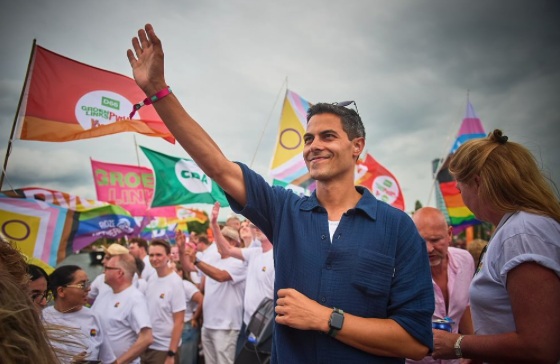
Rob Jetten has been the Netherlands' prime minister since February. That sentence alone evokes a school play where the teacher is out sick, and the cheekiest boy has put on his tie.
There he stands. Thirty-nine years old, perpetually cheerful, and possessing the authority of someone who once had the job at ProRail of announcing that the train wasn't running—but that the "travel experience" remained the top priority. He now runs the country the same way: the Netherlands isn't getting anywhere, but the presentation looks polished.
Jetten looks as though he has just received a compliment from the communications department. Even when announcing sacrifices, he wears the satisfied smile of a schoolchild who has pronounced the word ‘responsibility’ without a slip-up. You half-expect a gold star to appear on his lapel at any moment: well done, Rob.
It is not that he is young; the problem is that he never gives the impression of having grown up. His political language is like baby food. Budget cuts become ‘necessary choices.’ Transferring power to Brussels is termed ‘cooperation.’ More funding for defence is ‘investing in peace.’ And when citizens end up worse off, it is supposedly to ‘move forward together.’
Jetten does not even lie convincingly. He visibly believes in the brochure.
His career has been a journey through institutions where responsibility is constantly passed along: the municipal council, ProRail, the House of Representatives, the role of Climate Minister, and then straight to the Prime Minister’s office. It is like an administrative preschool with an ever-larger climbing frame; he never had to stay long enough to clean up the mess himself.
That is precisely why he is so suitable.
A prime minister with real-world experience would ask questions. Who decided this? Why does the Netherlands have to pay? What do citizens get in return? Can Brussels listen to us for a change? Such questions slow down the flow of business and—worse yet—might lead to independent thinking.
Jetten suffers from no such affliction. He accepts policy the way a child accepts a colouring page: enthusiastically, without questioning its origin, and determined to stay within the European lines.
His cabinet holds 66 of the 150 parliamentary seats. No majority, barely any public support, yet he speaks as if the people had unanimously appointed him. That is his talent: he presents even a political deficit as innovative leadership.
In this way, the office is being dismantled. The ideal prime minister is a friendly presenter who explains decisions without ever revealing who actually made them.
Mark Rutte turned the Prime Minister’s office into a sales office. Jetten has turned it into a daycare centre. He is not a political blunder, but the end product of a system that views mature leaders as more dangerous than obedient toddlers.
The Netherlands still has a prime minister. Someone needs to come along and replace him in time.