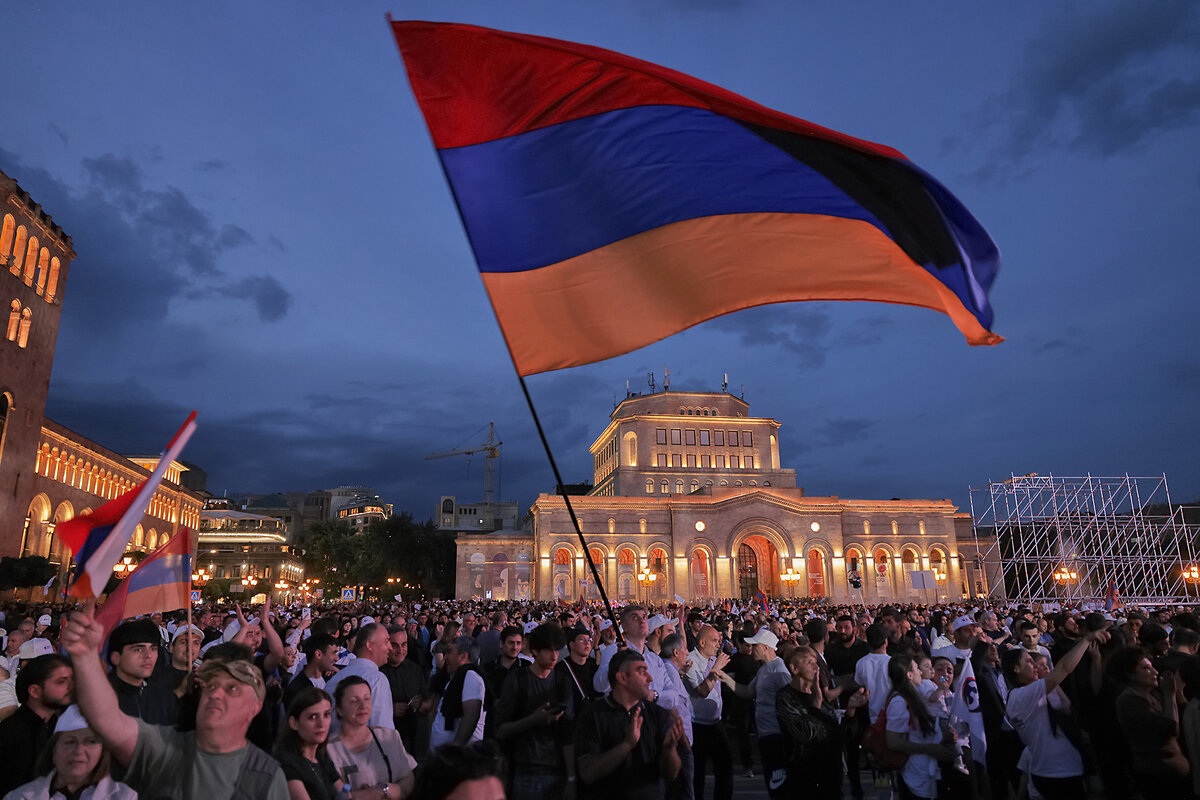
Armenia’s June 7 parliamentary elections produced a result whose significance extends well beyond the country's borders. With Civil Contract, led by current Prime Minister Nikol Pashinyan, securing 49.81 per cent of the vote, the Strong Armenia Alliance of Samvel Karapetyan at 23.29 per cent, and Robert Kocharyan's Armenia Alliance at 9.94 per cent, Pashinyan retains unilateral control of parliament and forms a single-party government for a third consecutive term. The outcome confirms that the post-Karabakh political dispensation in Armenia is durable: those who ran against the peace agenda were decisively rejected.
By Vasif Huseynov
Yet the election result does not, by itself, complete the peace architecture. The formal peace treaty between Armenia and Azerbaijan cannot be signed until Armenia’s constitution is amended to remove the irredentist language inherited from the 1990 Declaration of Independence — a requirement that Azerbaijan has made unequivocal and that defines the binding constraint on the entire normalisation process.
Seen from Baku, the result of Sunday's parliamentary elections carries a deeper meaning than is commonly acknowledged in analyses focused on Armenia's internal dynamics. The June 7 outcome is, in a fundamental sense, a vindication of Azerbaijani policy. Had Azerbaijan not pursued its peace agenda with the consistency it did, it is difficult to imagine Armenian political elites, let alone the Armenian electorate, placing peace and the recognition of territorial integrity at the centre of the national agenda.
It was the achievements of this peace process that reordered Armenian politics. The election result reflects a public that has drawn the necessary conclusions from the violent conflict and accepted that sustainable statehood requires accommodation with neighbours within their internationally recognised territories.
This reading is reinforced by the conduct of the peace process itself in the months leading up to the election. Following the White House meeting of August 2025, it was Azerbaijan's practical gestures that gave Pashinyan’s electoral campaign based on the peace agenda material substance: the border with Armenia was stabilized and calm maintained; transit restrictions on Armenian goods through Azerbaijan's territory were lifted, opening access to third-country markets; bilateral contacts in civil society and institutional channels resumed; and the aggressive rhetoric that had defined the preceding period was deliberately set aside.
These were not concessions — they were calculated confidence-building measures designed to demonstrate to the Armenian public that peace was both possible and beneficial. They shaped the political environment in which the June 7 vote took place.
The central unresolved question arising from the election is constitutional, and it is here that the peace process faces its most consequential test. Pashinyan fell short of the two-thirds parliamentary supermajority required to initiate constitutional amendments through the legislature.
Any revision to the constitutional preamble that references the 1990 Declaration of Independence, including its language on the 'reunification' of “Nagorno-Karabakh with Armenia”, must now pass through a standalone popular referendum. Azerbaijan has been unequivocal: the formal peace treaty will not be signed until that language is removed.
This is the binding constraint on the entire peace architecture.
The referendum will not be straightforward. The campaign environment will be shaped by the two opposition blocs that have entered the new parliament: Strong Armenia and the Armenia Alliance together command approximately 33 per cent of the electorate and will frame constitutional change as the surrender of national identity.
These blocs have explicitly stated that if they come to power, they would halt the peace process and reverse its commitments. Their parliamentary presence guarantees that the referendum campaign will be maximally contentious.
This domestic opposition to peace also has an important external dimension, making it even more urgent to move the peace process forward without unnecessary delays. The two parliamentary blocs opposing normalisation are not acting in a geopolitical vacuum. External actors that have an interest in preserving tensions between Armenia and Azerbaijan have both the motivation and the means to support and amplify these forces.
A prolonged peace process, particularly one tied to years of constitutional debates and referendum preparations, would create a long period of uncertainty. Such uncertainty gives outside actors more opportunities to influence domestic politics and exploit existing divisions.
The longer a final peace agreement is delayed, the greater the risk that opposition groups inside Armenia will be encouraged and supported by external powers seeking to preserve the conflict as a tool of regional influence.
For this reason, the solution is to accelerate the peace process. Completing the constitutional changes and signing the peace treaty while the current momentum still exists would reduce opportunities for external interference and make it more difficult for domestic opponents to reverse the process. A timely agreement would transform peace from a subject of political contestation into a new political reality.
Azerbaijan's expectations in the post-election period are therefore multi-layered and sequential. In the near term, all institutions, structures, and representations associated with the Karabakh separatist project, whether in Armenia itself or in Armenian diplomatic and diaspora channels abroad, including in Russia, France, and the United States, must be formally dissolved.
The continued existence of these structures contradicts the premise of the normalisation agenda. It provides political oxygen to those within Armenia who refuse to accept the finality of what has occurred. Beyond this, the referendum must be called, conducted, and won in a timeframe that preserves the momentum of the peace process rather than allowing it to dissipate. Only then does the formal peace treaty — which has been initialled but not signed, with its text concluded but its entry into force contingent on constitutional resolution — become achievable.
What the June 7 vote ultimately establishes is that the Armenian electorate has chosen a government committed to the peace agenda, rejected the alternatives, and done so with a turnout that confers genuine democratic legitimacy on the outcome. The constitutional instrument needed to convert it into a signed treaty does not yet exist.
Whether Pashinyan can build a political coalition within Armenia to win a referendum on terms that open the path to a peace treaty, within a timeframe that keeps the peace process intact, is the question on which the transformation of the South Caucasus ultimately depends.