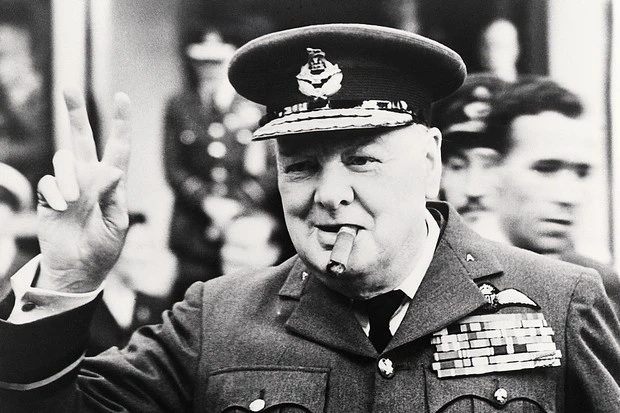
It is the summer of 1940. Air raid sirens wail over London as the Luftwaffe drops bombs onto the burning streets. Amidst the tremors, the British people hear a voice on the radio: crackling, resolute, heavy with whisky and cigar smoke. It is Winston Churchill. He does not speak of surrender, but of fighting on the beaches, in the fields, and in the streets.
By Ken van Ierlant
On the other side of the Channel, in Berlin, Nazi Propaganda Minister Joseph Goebbels watches through clenched teeth. He understands that he can only break the British armies if he first destroys the myth of their leader.
The German propaganda machine runs at full throttle. German fighter planes drop no bombs, but millions of leaflets that drift down over British cities. The message? Churchill is a drunken gangster, a bloodthirsty warmonger sacrificing your lives for his own glory. When Churchill proudly poses with an American submachine gun, the Nazis immediately print the photo with the text: Wanted for murder.
Yet, history has an ironic sense of humor. Instead of damaging Churchill, the British public embraces the poster. The Nazis' criminal becomes the ultimate British resistance hero. The attempt to isolate the leader from his people flops monumentally.
The theatre of power
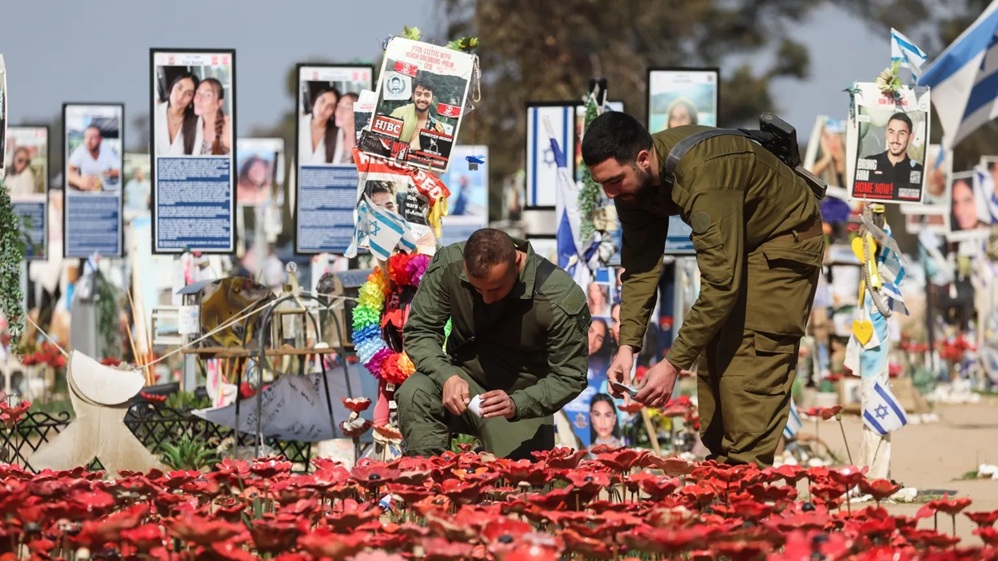
Fast-forward the clock to the geopolitical crises of the 2020s. The backdrop has shifted from the muddy trenches and smoking ruins of Europe to the arid, hyper-modern, and deeply tense Middle East. At the helm of Israel stands Benjamin Netanyahu. The bombs fall, and the sirens wail across the region.
Though the decades and ideologies are worlds apart, the political theatre is eerily familiar. Just as in 1940, a bitter battle for public perception rages alongside the physical warfare.
Regional enemies and international critics apply the same blueprint today as Goebbels did back then. They attempt to reduce the entire conflict to a single man. On hostile television networks and via radical Telegram channels, the same narrative echoes continuously: This is not Israel's war; this is Netanyahu's war.
He is framed as the ultimate 'warmonger', a cynical politician who refuses to lay down arms because peace would mean the end of his premiership. In international caricatures and street protests worldwide, his face is demonised, mirroring the caricatures of Churchill with his bottle of whisky in the Nazi newspaper Der Stürmer.
Words as weapons
Both leaders understood the absolute power of the word in times of existential fear. In 1940, Churchill spoke of a crusade for the survival of Christian civilisation against the darkness of Nazism. Netanyahu extends that same monumental line. In his speeches, he does not speak of a local border dispute, but of a clash of civilisations: the enlightened Western world against the "barbarism" of radical terrorism.
Both men dig deep into history to inspire their base. Churchill conjured the ghosts of Napoleon and the Spanish Armada; Netanyahu systematically reaches back to the memory of the Holocaust and the Biblical battle against Amalek. The objective is identical: to convince the population that there is only one option, namely total victory.
From leaflet to algorithm
Yet, there is one fundamental difference that makes the modern world far more unpredictable than that of 1940: the weapon used to fire the propaganda.
Goebbels had to wait weeks for printing presses, trains, and pilots to scatter his anti-Churchill leaflets over London. Today, the propaganda machine is decentralised and flashes across the globe at the speed of light.
Foreign troll factories do not need to send aeroplanes; they feed the algorithms of TikTok, X, and Instagram with deepfakes, manipulated videos, and inflammatory memes. In a fraction of a second, a doctored image reaches millions of living rooms worldwide, instantly providing emotional fuel for further polarisation.
Where Churchill back then held physical control over the BBC to protect his own narrative, a modern leader fights in a hyper-fragmented world. Netanyahu is exposed to a constant stream of both foreign digital attacks and fierce domestic criticism within a lively democracy.
History never repeats itself literally, but it does rhyme. Both in 1940 and today, we see that in times of deep crisis, the battle on the battlefield is inextricably linked to the battle for public opinion. And in that battle, the leader is always the primary target—and the most powerful weapon.