From Ramses to Trump: How a Biblical Narrative Became Modern Geopolitics
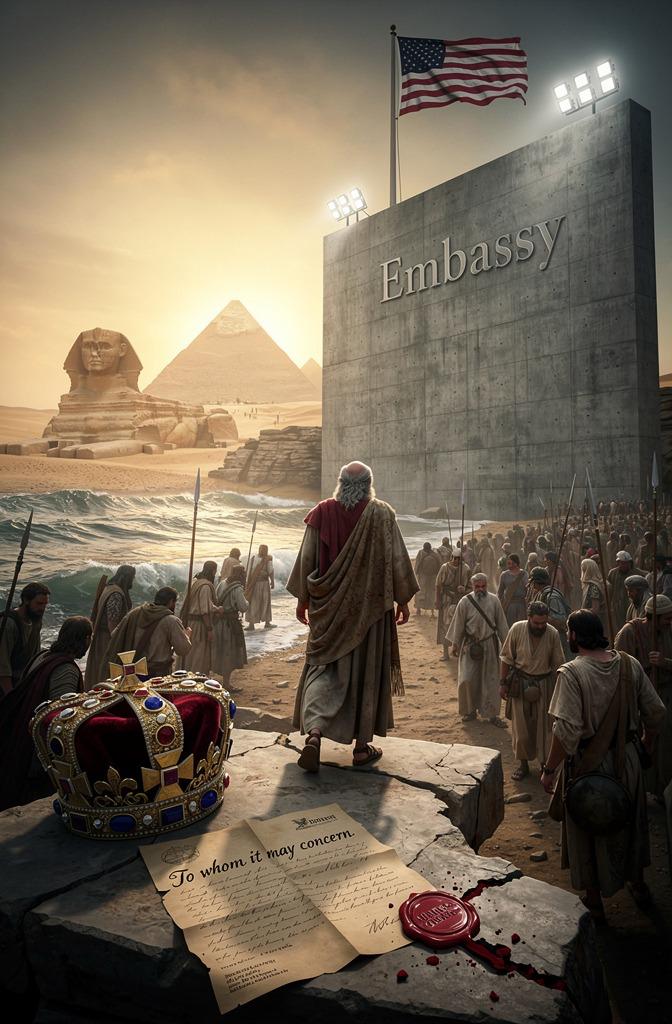
According to the biblical account, Moses led God's chosen people out of Egypt through ten plagues, parted a sea, wandered forty years through the desert, and finally reached a land they had never seen.
History, or at least some historians, offers a rather less miraculous version.
Ancient Egyptian writers such as Manetho and Chaeremon described the Israelites not as enslaved builders escaping oppression, but as an impure, rebellious population whose presence supposedly angered the gods and brought calamity upon Egypt.[1,2] Whether interpreted literally or metaphorically as "lepers," they were, according to these accounts, expelled by the Pharaoh in what amounted to a state-managed deportation.[1,2,3,4,5]
Moses himself may not have been the liberator tradition remembers. His unmistakably Egyptian name—derived from the root ms ("born of") found in names like Ramses and Thutmose—suggests deep ties to the Egyptian court.[1,2,3,4,5] Some theories even portray him as the official who organised the departure, or the leader who escorted an unwanted population beyond Egypt's borders.
The earliest non-biblical mention of Israel appears on the Merneptah Stele, erected around 1208 BCE, proclaiming that "Israel is laid waste; its seed is no more." Whatever happened during the Exodus, a people called Israel had already emerged in Canaan by the late thirteenth century BCE.[1,2,3,4,5]
Today, most archaeologists and Egyptologists do not consider the Book of Exodus a literal historical account. As William Dever wrote:
"Rather than attempt to defend the factual historicity of the Exodus traditions, we must understand the Exodus story precisely as a myth—a metaphor for liberation."
Scholars such as Israel Finkelstein and William Dever argue that the narrative likely evolved from distant memories of the Hyksos expulsions, later reshaped into a foundational national story.
Then history moved on.
Nearly three thousand years later, another empire entered the story.
In 1917, British Foreign Secretary Arthur Balfour issued the Balfour Declaration, promising support for the establishment of a "national home for the Jewish people" in Palestine—not a sovereign state—in a letter addressed to Lionel Walter Rothschild.
This was not an act of post-Holocaust repentance. It came during the First World War, decades before Nazi Germany existed.
The declaration was later incorporated into the British Mandate over Palestine following the collapse of the Ottoman Empire. Although it explicitly stated that "nothing shall be done which may prejudice the civil and religious rights of existing non-Jewish communities in Palestine," British policy increasingly empowered Zionist institutions while the Palestinian Arab majority watched its political future steadily erode.
Ironically, Balfour himself had previously championed Britain's Aliens Act of 1905, legislation largely aimed at restricting Jewish refugees fleeing persecution in Eastern Europe.
Several historians argue that support for a Jewish homeland was motivated not only by Zionist aspirations but also by a desire to redirect Jewish migration away from Britain itself.
History has a habit of repeating itself with better stationery.
The project accelerated throughout the twentieth century, culminating in the establishment of the State of Israel in 1948, the occupation of East Jerusalem and the West Bank after 1967, and decades of expanding settlements despite repeated international objections.
Then came Washington.
In 2017, exactly one hundred years after the Balfour Declaration, President Donald Trump formally recognised Jerusalem as Israel's capital. He ordered the relocation of the U.S. embassy from Tel Aviv to Jerusalem.
More than a diplomatic gesture, the move represented a decisive break with decades of American policy, which had treated Jerusalem's final status as a matter for negotiation. It was celebrated by the Israeli government, condemned by much of the international community, and widely viewed as granting political legitimacy to Israel's claim over the city while sidelining Palestinian aspirations.
From Ramses to Balfour to Trump, the actors changed.
The script barely did.
A story that may have begun as myth became empire. Empire became diplomacy. Diplomacy became statehood. Statehood became an occupation. Occupation became international policy.
Karl Marx famously described religion as "the opium of the people."
In 2026, one might argue that the political ideology of Zionism—at least in its most expansionist and exclusionary forms—has become something else entirely:
Not an opiate.
A metastasis.