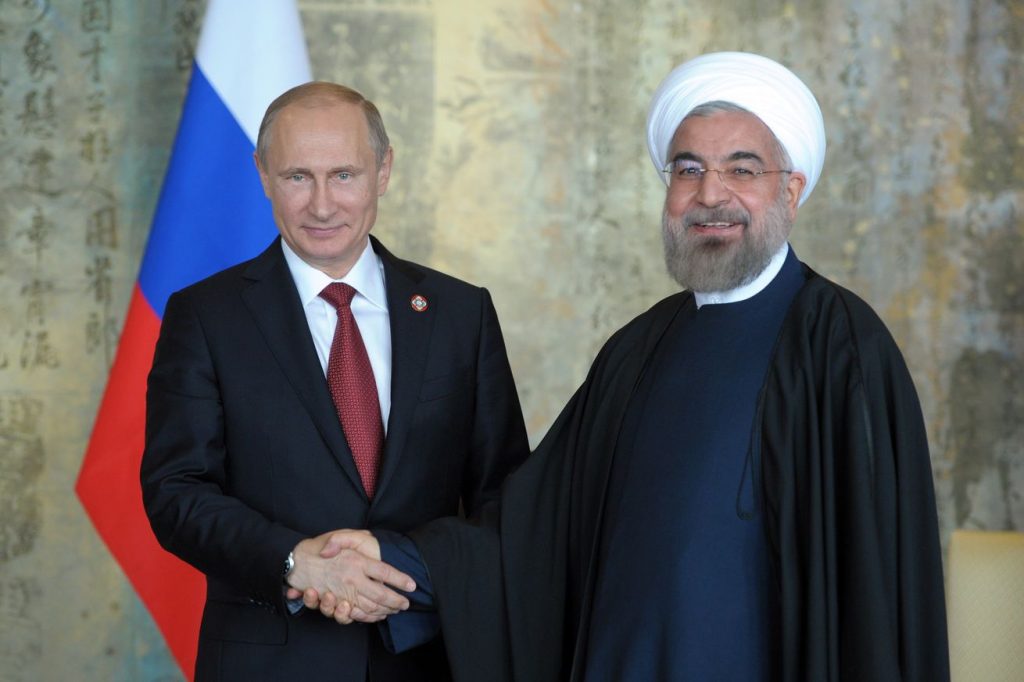
Following the conclusion of a $400 billion strategic agreement with China, Iran aims to sign a long-term partnership agreement with Russia. From the Islamic Republic’s perspective, good relations with Moscow and Beijing, as well as the possibility of expanding economic cooperation with the two countries, will help Iran more easily cope with U.S. sanctions and avoid the international isolation that Washington is trying to impose.
By Nikola Mikovic
According to Iranian Foreign Minister Javad Zarif, who recently met with his Russian counterpart Sergey Lavrov, “a long-term deal with Russia is on the agenda”. It is worth noting that Moscow and Tehran signed a long-term agreement in March 2001, which expires next year.
Despite the agreement on a strategic partnership, Russia refused to sell S-300 to Iran in 2010, bending to pressure from the United States and Israel. Last year, Moscow also refused to provide Iran with an S-400 missile system, even though this request allegedly came from the very top of the Iranian political leadership. Kremlin officials explained that “the sale would stoke more tension in the Middle East.”
In other words, Russia tried to avoid any confrontation with major Western and regional powers over this very sensitive matter. On the other hand, the Kremlin did not hesitate to provide this weapon system to the NATO member state, Turkey. In any case, it remains to be seen if Russia will once again fail to supply arms to Tehran, or if it will ignore the US calls to respect the international embargo against Iran.
With or without Russian weapons, Iran, on the other hand, will likely continue to wage hybrid wars in the Middle East effectively and also tend to preserve the Shiite Tehran-Beirut bridge. The Islamic Republic, unlike other Russian “partners” and “allies”, is not in a position to heavily depend on Russian military and economic support, nor does it depend on Russian oil and gas.
Over the years, Iran has developed its own military-industrial complex and a relatively self-sufficient agricultural system, which means it does not critically depend on food imports. Thus, Tehran appears prepared for a prolonged period of sanctions and isolation, while simultaneously seeking to avoid the worst-case scenario by signing agreements with Russia and China.
Although the Western media tend to portray Russia as the Iranian ally and a strategic partner, the two countries have a long history of wars, disputes and mistrust. Also, they were often on opposite sides during the major crises they faced. For instance, during the Iran-Iraq war, 1980-1988, the USSR supplied Saddam Hussein with large amounts of conventional arms, while throughout the 1990s and in the following decades, Russia abandoned Iran at every juncture whenever its interests required it.
The Kremlin
The Kremlin has historically used Iran as a counterweight or source of leverage to balance its relations with Western powers, particularly Washington. For instance, Russia did not hesitate to vote in favour of all six resolutions passed at the UN Security Council against Iran from 2006 to 2010. Also, in May 2019, Russian President Vladimir Putin stated that Moscow “is not a fire brigade, and cannot save just everything,” implying that Russia cannot help Iran in its tensions with the US.
The coronavirus pandemic has brought many changes to world politics, which means that it is not impossible for Russia to change its policy toward Iran and to form a sustainable alliance with Tehran. However, at this point, such an option does not seem very likely. Given that Russia remains heavily dependent on the West, particularly economically, it is unlikely that the Kremlin will risk incurring further sanctions by deepening its ties with Tehran.
Finally, the very fact that Russia, to this day, refuses to protect Syria from constant Israeli air strikes is a clear indication that Moscow will likely keep making concessions to the West, which means that, in case of an unlikely major war in the Middle East, Iran cannot count on full Russian support.
Nikola Mikovic is a Serbian journalist and a senior Geopolitical Analyst.




Ask yourself,
What will happen to all of this tension
when President Trump
declares demurrage on The US dollar?
The answer:
Money
could no longer be used as a weapon;
holding IT hostage
unless
the ransom
(the interest tribute)
is paid
for setting the money free.
But it must always be remembered
that money
is essential for the division of labor.
Civilization is built
on the foundation
of the division of labor.
And the division of labor
rides
on the shoulders of money.
Money is indispensable.
Whoever holds it KNOWS this.
And will commit usury
to embarrass
whoever asks for it.
Why?
Because money
in the form which we know it today; traditional money
is able to be hoarded
and used to manipulate market conditions.
Unhoardable Money with demurrage,
like The US dollar with demurrage
will ease the tension
and inspire
reciprocal trade
in its place.
It will even inspire
Cooperative competition
and
competitive cooperation.
It will not inspire
Usury.
Cheers
Angel NicGillicuddy