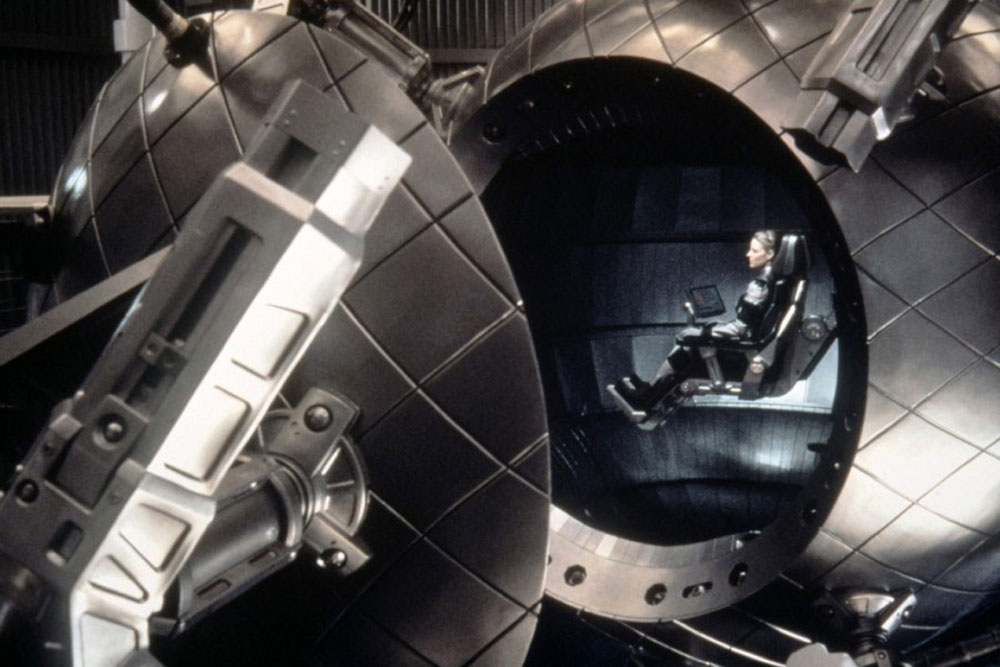
“Beauty is the radiant bridge to the future which the science-fiction writer must cross on his journey into times to come.”
— Ivan Yefremov
On a previous occasion I had the privilege of reviewing Jörg Matthias Determann’s Space Science and the Arab World: Astronauts, Observatories and Nationalism in the Middle East (2018)[1]. Now I have the even greater privilege of reviewing his new book Islam, Science Fiction and Extraterrestrial Life: The Culture of Astrobiology in the Muslim World (2020), and for several reasons too.
By Emad Aysha
It’s written in a very different way from the previous book, which makes it a much easier, smoother read. The first was the work of a professional historian, minus all the academic terminology that bogs people down or puts them off. Islam, Science Fiction and Extraterrestrial Life is more like the work of an investigative journalist and sci-fi enthusiast, although written with the same precision, acumen and attention to veracity and detail that you’d expect from a historian. Stylistically, the book is far more emotive and retrospective than Space Science and the Arab World, and reading that initial book was a beaut.
It’s not ordered chronologically, as each chapter is on a distinct topic and begins with a dramatic entrance only to trace back to the origins of this development. This has the added advantage of grabbing the reader and posing unanswered questions in the reader’s head that the author proceeds to answer methodically just by filling in critical gaps in our knowledge. This facilitates comprehension, especially for the non-specialist reader. While the book is, in fact, a little longer than its predecessor, at 288 pages compared to the older 272, it feels smaller and is a significantly faster read.
The opening chapter begins with the story of Ayham Jabr, a very talented and tenacious concept artist from Syria who has survived and even thrived against all odds in his beloved war-torn country. The front cover of Islam, Science Fiction and Extraterrestrial Life is an illustration by Ayham, in point of fact, and a wise choice too since I know him myself and have some of his works in my first published story, also in point of fact.[2] Ayham did sci-fi conceptual drawings juxtaposing Arab and Islamic settings very authentically with images of flying saucers and invading aliens disturbing the natural peace, making ISIS fighters out to be such foreign, loathsome, incomprehensible entities.
This was the entry point Dr Jörg needed to swoop us into the book's subject matter: the Arab-Muslim attitude and contribution to astrobiology, and the debate about the existence of life in the universe beyond the planet Earth. His message with this opening chapter and opening account is that wondering about the existence of life elsewhere is no stranger to the Muslim and Arab frame of mind. It’s something that goes on today in the most extreme of circumstances and so could easily have existed before, during better life conditions, and in fact did. More than this, the search for extraterrestrial life was almost part of the Arab and Muslim quest for modernisation and rebuilding of their civilisation; to stake their claim in the game of nations and world powers.
Between evolution and the extraterrestrial
Muslims have dreamed of the possibility of life and first contact with alien civilisations throughout modern history, particularly after they came into contact with the Copernican heliocentric model of the universe, and have actively participated in the quest to find such life through scientific research. If anything, Muslims were more open-minded than their Western counterparts over the centuries. This comes out both in their science fiction and in their science, including their contributions to astrobiology, astronomy, the search for planets outside the solar system, and their work with foreign space agencies like NASA.
Religion, amazingly enough, is not a barrier at all, to the point that many Arab scientists and Muslim science fiction writers have speculated that life on Earth itself originated from the stars, with alien bacteria making their way into our atmosphere or extraterrestrials seeding the planet with life on purpose. This came out, amazingly enough, in a special issue of Al-Hilal magazine in Egypt as far back as 1922, with speculations about the suitability of different planets in the solar system for sustaining and evolving life (Determann, pp. 60-61).
Closely related to this is the surprising openness of Muslims, especially in the 19th and early 20th centuries, to evolutionary theory, to the point that Western, and invariably Protestant, missionaries to the Arab world were actually the ones hostile to the teaching of Darwinism, not their Arab-Muslim hosts. I was particularly happy to find that the nefarious character of Cornelius Van Dyck, an evangelical modernist who saw Islam as antithetical to scientific progress, “left the Syrian Protestant College by the mid-1880s following a controversy over Charles Darwin’s work” (Determann, pp. 53).
Even more ironically, the Jesuits, being Catholics and not adhering to a literal-fundamentalist reading of the Bible, also had fun teaching Darwinism. I can chip in here regarding Muslim receptiveness to evolutionism. While researching an article on the Iranian revolution and the role that revolutionary thinkers like Ali Shariati played, I stumbled upon repeated references to both evolution and Darwinism.
I queried a noted Iranian American on the matter, a professor of Islamic Studies in the US, asking him if Shiites had an evolutionary perspective, and he said yes. He explained that the rationalist, Aristotelian tradition in Shiite fiqh (jurisprudence) believed that all the important questions had already been asked and answered by the great philosophers.
So all that was left to do was preserve the past, a near-impossible task given the corruption of time, as old sources and texts corroded and were forgotten. The Usulis, by contrast, insisted that they had compiled a science for authenticating and checking jurisprudential knowledge, putting them on a better footing than their ancestors, and thus making progress in the history of knowledge possible, so that people could understand their religion better and be better Muslims in the future. Watching an interview with President Khatami, I once found him constantly referring to the history of religion in evolutionary terms, as part of man’s quest towards better things, as part of the whole story of creation.[3]
Do a little historical digging, and you discover that Muslims actually helped propagate evolutionary theory to begin with, particularly the great scientist and scholar Al-Jahiz in his Kitab al-Haywan [Book of Animals], a guy who extolled an evolutionism so extreme it bordered on Social Darwinism. He even questioned Adam as the exclusive father of humanity.[4]
The ancient mind was much more flexible than the modern mind because mass communication and mass education set limits on what is scientifically and religiously acceptable knowledge. People in the olden days believed anything anyone told them about far-off, mysterious lands and mythical beasts. They were more radical in their interpretation of or disregard for scripture.
We can add Sufism here since it is explicitly evolutionary, with spontaneous generation famously leading to the genesis of Hayy ibn Yaqzan. At the same time, Sufi alchemy holds that all lower life forms and inanimate objects aspire towards intelligence, conscience, and perfection.
Hence, the base metals wanting to become gold and silver, and also plants wanting to be like human beings in form, which explains the palm tree – a plant with no branches and only a head, a plant that dies when that head is chopped off, just like a human being. (I’m getting this from the Ikhwan Al-Safaa movement, a philosophical movement with Sufi and Shiite leanings). Wouldn’t you know it, here is a snippet from Dr Jörg’s book:
Despite limits on the teaching of evolution, the theory persisted in the mythology of the World Brotherhood Union. ‘An entity which was once a Cat, a Dog, an Ape, a Bird can become one day a Human Being’, said The Knowledge Book. ‘Do not ever forget that the theory of Darwin can never be underestimated.’ In Bülent Çorak’s imagination, evolution is progressive, teleological and theistic. ‘God has designed an Evolutionary Tableau in accordance with His System of Creation’, her scripture explained. ‘The Single Cell which came into existence is always on the Evolutionary path which leads it to becoming a Human Being.’ (Determann, pp. 195).
It seems that Arabs and Sunni Muslims were just as receptive to Darwinism as their Shiite and Sufi counterparts were in the early days. Still, something went wrong in the meantime, either because of the confrontation with the West or because they lost touch with their wider Islamic heritage. This seems to have occurred in Turkey, with figures like Harun Yahya (actually Adnan Oktar) attacking evolutionary theory and palaeontology-archaeology and substituting them with his own brand of creationism, in line with rising Islamism in Turkish politics (Determann, pp. 195).
Ironically, in Islamist Iran, that older synergy with the evolutionary perspective on time has continued and remained alive and well, even in works of science fiction, as evidenced by author Iraj Fazel Bakhsheshi (Determann, pp. 194-195).
Sadly, like everything in life, there is a downside to all this. Arabs and Muslims are very susceptible to conspiracy theories – the notion of being the plaything of greater power, terrestrial or ‘otherwise’ – and they’re also fond of imbibing other people’s conspiracy theories, extraterrestrial included (Determann, pp. 104, 110, 130-131). And so UFO cults are a big part of modern Islamic history too, and evolutionism, sadly, is wrapped into them.
The classic example, of course, is the Nation of Islam in the US, with the claim being made that Elijah Muhammad is still alive and well, on board an orbiting mothership, and waiting to return like the Mahdi-Messiah to right all the wrongs of the world in millenarian fashion.[5] Less well known is a movement established in Turkey called the World Brotherhood Union, begun by the woman activist Bülent Çorak in Istanbul in the 1980s.
Çorak believed in reincarnation, in Sufi fashion, and then claimed to be receiving extraterrestrial messages, with a mothership also headed towards Earth that “sought to unite humanity and bring about a golden age through UFOs” (pp. 125). Her movement was also very feminist, giving women a unique role in this spiritual communion with aliens, since the approaching vessel (conveniently) complains that: “Sex discrimination exists only in Your Galaxy” (Çorak, 1984, quoted in Determann, pp. 125). More than that: “Undeveloped Societies will be annihilated in proportion with the torment they cause for women. Do not ever forget this” (The Knowledge Book, quoted in Determann, pp. 125).
It’s good to see that lunacy is an equal-opportunity employer, but, more to the point, this is a common psychological scenario when it comes to the downtrodden of the earth. There’s a similarly themed story in the Palestine + 100 anthology, aptly titled “Final Warning” by Talal Abu Shawish.
The clear implication is that the only way Arabs and Israelis can ever live in peace is if some external agency from the heavens interferes because human beings are too petty, selfish and nearsighted. This, in principle, is not that different from what you get in Nehad Sharif’s Martian epic Number 4 Commands You, also with warnings about the threat of nuclear war and celestial intervention.
Wouldn’t you know, I had a story in Palestine + 100, but typically for me and my social science frame of mind, I didn’t have any aliens, leaving the human beings to sort things out. If only I’d conveniently forgotten my PhD and my university studies, I could have had an alien story to my name and had it mentioned in Dr Jörg's book!

SCIENTIFIC EMBRACE: Dr Determann in the flesh with his path-breaking book on the openness of Muslim scientists, and science fiction writers, to extraterrestrial life. Picture taken from 'Baladi' magazine. [See below]
The illuminations of the silver screen
Something else very interesting and very different about this book is that Dr Jörg devotes a large chunk of it to cinema, to the point that we discover that Muslims had made early forays into SF cinema, specifically in outer space exploration and first-contact movies. The country mainly responsible for this was Turkey, in the secular era, but also Pakistan and India and Egypt, but to a lesser extent.
These movies, specifically the Turkish variety, were quite rowdy, with a fair amount of sex or sexual allusion in them and seemed to be borrowing from a stock set of images derived from Orientalism, with the harem and slave girls and belly dancers and decadent Sultans.
As I’d suspected all along, Orientalist imagery exists in science fiction and from its earliest days, certainly the filmed variety. There are depictions of crescents and beautiful women in the royal palace, as in A Trip to the Moon (1902) by Georges Méliès (Determann, pp. 78-79), while both Méliès and Jules Verne themselves produced many Orientalist works. Dr Jörg then poses the question as to why such films succeeded, to a considerable extent, in Turkey but didn’t catch on in Iran: “This raises the question whether secularism was more permissive of the scientific imagination than Islamism” (Determann, pp. 36).
I ‘may’ have an answer here as a fan of contemporary Iranian cinema and given my previous research on the intellectual background to the Islamic revolution. I don’t think that secularism was the chief culprit in this dearth of SF movies since the country was as captivated by secularism under the Shah as Turkey was under Ataturk.
Check out YouTube, and you can find endless Iranian black-and-white movies that are downright ‘exploitation’ movies, with belly dancing, bikini-clad babes and even some nudity. It seems that the interests of Iranians lay elsewhere, in social and philosophical concerns, evidenced by movies like The Cow (1969) and Dosh Akol (1971). The dominant genre of movie and TV serial in Iran nowadays, their force multiplier that they are exporting to the world and winning prizes for, is Ejtema’iee Movies, social dramas, along with the more culturally exotic presentations of tribal peoples you get in classics like Gabbeh (1996) and Sukout (1998) by director Mohsen Makhmalbaf.
Iranians, moreover, are very concerned with distinguishing themselves, doing things their way or on their terms. They’re never content to imitate others, however much they admire those others and want to learn and interact with them. Check out the Oscar-winning The Salesman (2016), and you have a scene where a school kid is asking why Iranians insist on mispronouncing BMW. I once read a story by Sadegh Hedayat (1903-1951), and you have a historical story in which an Iranian Buddhist insists on drinking wine as part of his religious rituals, giving Buddhism a distinctly Persian flavour.
However, Buddhist monks aren’t actually allowed to drink. Hedayat himself, while an avowed atheist and modernist writer trained in France, was also very sceptical of modernity and how disenchanting and coldly materialistic it was and often used religious imagery in his writings to convey his defiance of certain tenets of Western civilisation. You could argue, as I do in my own research, that this rejection of the West itself developed out of the very familiarity Iranians have with the West, having studied its philosophy in depth and thus being all too aware of the antagonisms and contradictions in its civilisational history. You can see this in everybody from Sayyed Hossain Nasr to Ali Shariate – the book to reference here is Mark Sedgwick’s Against the Modern World: Traditionalism and the Secret Intellectual History of the Twentieth Century (2004).
Turks are a very proud people, true enough, but they’ve spent most of their time trying to be European, even before Ataturk. Hence, Turkish SF cinema, along with action, suspense and horror. Now that Iranians are on firmer cultural ground and more artistically self-confident, you get in-depth SF literature and some SF cinema, as documented in Dr Jörg’s book.
This also goes to show that the natural antidote to Orientalism in literature, cinema and visual arts is more and more art produced by us Orientals, on our own terms and showing us as we in fact are, warts and all. Dr Jörg himself cites Iraq+100: Stories from a Century after the Invasion in this regard as one of the contributors to the Comma Press anthology, Hassan Abdulrazzak, explained: “Arabs tend to get portrayed in Western culture as conmen, religious fanatics or terrorists… I wanted to show authentic Arabs, the kind of people I know. I grew up with, who are interested in the arts, who drink and smoke, and whose social relationships are not governed by taboos” (Abdulrazzak, quoted in Determann, pp. 192).
As for exploitation movies and SF, I could add here an insight derived from a lecture by Lebanese translation researcher Maya Kesrouany.[6] She explained that translations of modern Western literature included Jules Verne and H.G. Wells. So there was hostility to science fiction as such, but the chief area of interest for translation was detective novels.
It seems, in answer to my query, that the ‘scientific method’ evident there is what captive translators, publishers and readers quenched their thirst for modernisation with, SF falling behind as a consequence. This makes perfect sense to me because, to this day, spy literature, horror and SF are classified as ‘police novels’ (riwaya al-bulisiya) in Arabic literary thinking and so seen as secondary and mediocre compared to social realism. This would also explain why the most successful SF writers in the Arab world, and not just Egypt, were the pioneers of the pocketbook adventure series – Nabil Farouk and Ahmed Khaled Tawfik. And the bulk of what they wrote wasn’t necessarily SF, and when they did write SF, it was mainly in the adventure or detective story format.
This truism seems to hold for Pakistan and Malaysia as well, given that the early SF writers there also wrote detective stories, if not sacrilegious erotic thrillers in the James Bond mould; Pakistan’s Ibne Safi (Asrar Ahmad) and Malaysia's Faisal Tehrani (Mohd Faizal Musa), to cite Dr Jörg.
I’m clearly in the wrong line of business, although there’s no shortage of sexual allusions in what I’ve tried to publish, in English. Guess I came too late in the game. There was never any political correctness in Sean Connery’s day!
A conclusion missing in action
My only qualm here, conceptually, is the need for an extended discussion of the concept of ‘alien’ and the different terms used over the years to designate extraterrestrial life. Americans are very unique for their use of the word aliens for what used to be called ETs. Let me illustrate my point here.
There’s a wonderful story by Sever Gansovsky called “The Black Stone (Черный камень)” in which an artist living in isolation in a cabin encounters an alien life form that imitates the evolutionary stages of life on Earth until it resembles a human being. The creature, however, is always referred to as an extraterrestrial. At the same time, the painting the artist is working on is, interestingly, called ‘alienation’, since it depicts a tree in the forest all by itself.
Therefore, the modern usage of the word alien is very American and more of a political designation, as in "illegal alien," that has moved into science fiction for some strange reason. Alien, moreover, originally means stranger, as in alienation – becoming a stranger to yourself, the original Hegelian usage. (Welsh, for instance, is an Anglo-Saxon word that means ‘foreigner’).
The person to consult on all this is Marie Lathers, author of Space Oddities: Women and Outer Space in Popular Film and Culture, 1960-2000 (2010).[7] But highlighting this language angle is doubly important once you cross the Anglophone-to-Arabic language barrier, let alone other languages like Turkish or Urdu.
In Arabic, marrying someone who isn’t your cousin means marrying ‘the stranger’ (algharib), with all that implies in the form of mistrust. I can’t give any ready answers here. Still, I’d suspect Arabs and Muslims are more relaxed about extraterrestrials than their Western counterparts because we consider our next-door neighbours in the same country to be aliens, aka strangers, envious of our status and belongings. So creatures from outer space would actually be less threatening!
My only qualm empirically is that some of the younger Arabic authors should have been included in the study, chief among them Wael Abdel Raheem and his brother Mahmoud, authors of Akwan (Universes), and Ammar Mahmoud Al-Masry, author of the alien invasion-first contact Atlantis trilogy. Akwan is very interesting because the aliens are actually here on Earth, living in parallel dimensions, with a scientific experiment in the Bermuda Triangle threatening to reopen the gates that have kept these worlds separate. (Dr. Jörg mentioned the Bermuda Triangle himself (pp. 130-132, 145).
One of the dimensional worlds also includes genies, and the human scientist trying to breach the barriers between these worlds is an Egyptian and was raised by a sheikh who uses the Quran to tame evil spirits, warning his son against playing with fire. This gives an original twist to extraterrestrial life in the corpus of Arabic and Muslim SF and also gives a slightly different look at genies, who are ultimately benign here and trying to defend humanity against the impending doom of the pan-dimensional breach.[8]
As for Ammar Al-Masry, he combines fears about artificial intelligence – a robotic rebellion – with alien visitations in the distant past with first contact and alien invasion in his three Atlantis novels, with many more to come. The glue that unites it all together, amazingly enough, is the situation in Syria – the maniacal civil war post-Arab Spring. In the first novel, Shadow of Atlantis, strange metallic probes crash-land on Earth and release a signal that triggers a robotic rebellion; the sequel is Throne of Atlantis.
A select few humans who survive the onslaught are then given superpowers and trained to fight for humanity’s independence. By the third novel, Heart of Atlantis, however, they discover they’ve been duped and are actually on another planet entirely. They take opposing sides and end up fighting each other instead of the common enemy.
All of this is an allusion, again, to the Syrian civil war, with fellow Islamists fighting each other as world powers jockey over the spoils of the desiccated country. The alien civilisation-galactic empire of Atlantis is also meant to stand in for Islamic history, the rise and decline of the Ottomans specifically. At the same time, the crystal orb used by the people of Atlantis to advance their civilisation and power everything – it turns out – is a reference to Arab oil!
I can add a snippet here. While teaching at the American University in Cairo, I used clips from the movie version of Dune (1984). My students very wisely noted that the planet Arrakis, or Dune, is actually Iraq, while the Padishah Emperor Shaddam IV is Saddam. I’d always suspected the spice was a reference to oil, since Arrakis is a desert planet and, without the spice, interstellar travel is impossible.
It’s long been known that the Fremen, the desert nomads that populate Dune, are modelled on Arabs, and Dr Jörg says here that Frank Herbert was a big fan of Lawrence of Arabia (1962). Herbert has been charged with being an Orientalist himself, mind you.
Still, his portrayal of Arab Muslims is actually a bit too positive and romantic for that charge to hold, and Lawrence of Arabia as a movie is actually very popular in the Arabs world if only because it shows Arabs as they are, warts and all.
My preferred cinematic model for presenting desert Arabs to sci-fi audiences is the Anthony Quinn movie Omar Mukhtar, and the battle sequence in my own story “Lambs of the Desert” is in part inspired by the tank battles in Lion of the Desert (1980). Even the title ‘lambs’ is a play on ‘ Lion of the Desert ‘. But sadly, there are no aliens again. I was busy trying to make the Arabs anew on the desert planet of Mars but didn’t think to have an external agency involved, just blasted human social scientists.
I’ll say one more thing here before signing off. Dr Jörg doesn’t seem to be getting the kind of critical attention he deserves, whether by academics or SF writers. He writes the Preface; there is no Afterword, and it would have been really cool if you had a big SF name or an outside expert endorsing this monumental achievement with an Introduction. I’m going to ‘pretend’ that the ill effects of COVID-19 on the publishing industry are responsible for this. Let’s hope a new and worse epidemic doesn’t hit the paperbacks sector when Dr Jörg does a third, and I’m sure even cooler book!!!
References
[1] Emad El-Din Aysha, “BOOK REVIEW – A GERMAN WITH A PULSE ON ARAB’S SCIENTIFIC FUTURE!”, Eksentrika, 18 July 2018, https://eksentrika.com/book-review-a-german-with-his-pulse-on-arabs-scientific-future/.
[2] My first short story, “A Detour in Space,” has since been annotated in a book on dystopian literature. Please see Utopian Literature in English: An Annotated Bibliography From 1516 to the Present, by Lyman Tower Sargent, (Submitted by LT_Sargent on Tue, 06/02/2020 – 11:00), a Publication of Penn State Libraries Open Publishing, https://openpublishing.psu.edu/utopia/content/detour-space
[3] Please see my article “Foucault’s Iran and Islamic Identity Politics Beyond Civilizational Clashes, External and Internal”, International Studies Perspectives, Volume 7, Issue 4, November 2006, Pages 377-394, https://doi.org/10.1111/j.1528-3585.2006.00260.x, specifically pages 387-388.
[4] Please see Mehmet Bayrakdar, “Al-Jahiz and the Rise of Biological Evolution”, The Islamic Quarterly, Volume 27, Number 3, 1983, pp. 307-315, http://dergiler.ankara.edu.tr/dergiler/37/772/9842.pdf.
[5] Please see Dennis Patrick Walker’s review of The Nation of Islam in North America Countdown to Armageddon: Louis Farrakhan and the Nation of Islam (1996) by Mattias Gardell, published in the Journal of Muslim Minority Affairs, October 1998, Volume 18, Number 2, pp. 369-379. See also Walker’s own book on the topic, Islam and the Search for African-American Nationhood: Elijah Muhammad, Louis Farrakhan, and the Nation of Islam, Atlanta: Clarity Press, 2005.
[6] Dr Kesrouany is Assistant Professor of Literature and Middle Eastern Studies at New York University in Abu Dhabi. Her lecture was entitled “Prophetic Translation: The Making of Modern Egyptian Literature”, Centre for Translation Studies, American University in Cairo, 22 October 2019.
[7] Please see my own essay in this regard, “Alien Abduction Scenarios, Through a Gendered Lens: Crisis of the White Man’s Burden?”, in Geek Out! II: Queer Pop Lit, Art & Ideas, 2019.
[8] Ammar has an unpublished novel with a similar theme about a pan-dimensional device that wreaks havoc on humanity, with the jinn not the guilty party and not even resembling the classic devils with hooves, horns, and leathery wings. He also toys with notions about man’s origin and how humans may have evolved biologically on Earth but had a divine coupling that made them spiritually human, again in line with many evolutionary speculations in modern Muslim history.
Reprinted with permission from 'Eksentrika', posted on originally 20 Jan 2021, https://www.eksentrika.com/review-islam-science-fiction-and-extraterrestrial-life-by-dr-jorg-matthias-determann/.
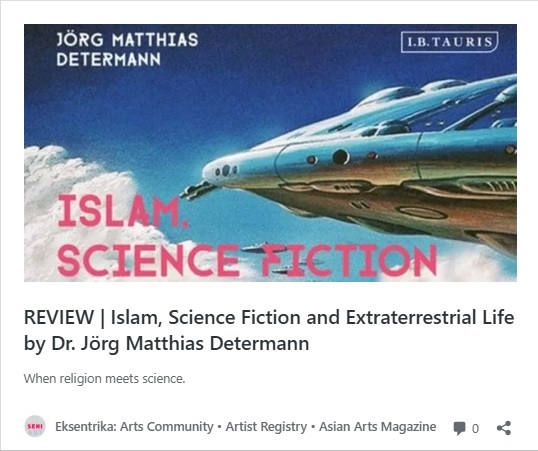
SCIENCE SNAPSHOT: A screen capture of the original 'Eksentrica' review, celebrating marriage of science with religion in the pursuit of truth.
The text is essentially the same with new pictures and captions added, and with permission from 'Baladi' magazine's own review of Dr. Determann's work: Explore: Islam, Science Fiction and Extraterrestrial Life – a Study by Dr. Jörg Matthias Determann – Baladi