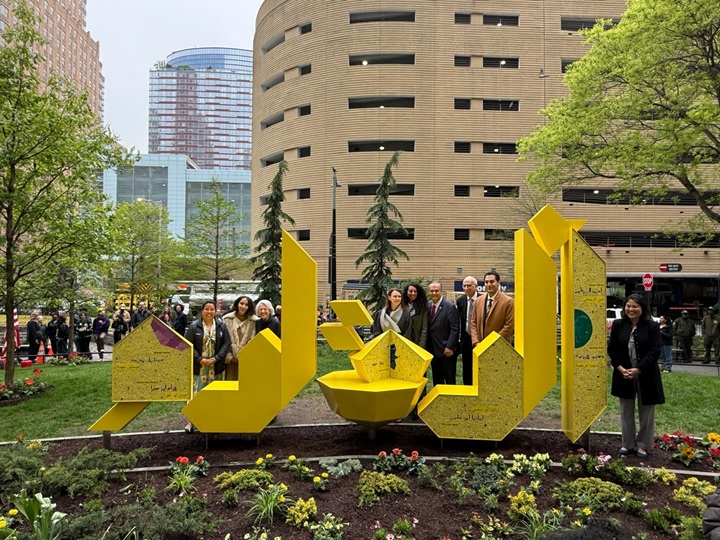
When I published “Who Gets to Name the Dead?” earlier this month, I did expect a resolution. Not because the argument was unanswerable, though I believe it is, but because when two Lebanese ministries engage diplomatic channels over a plaque on a monument in Lower Manhattan, the outcome is rarely left to chance. That machinery, once set in motion, tends to arrive somewhere. And it has.
By Glen Kalem-Habib
The Washington Street Historical Society, the organisation that commissioned ‘Al Qalam: Poets in the Park’, has agreed to update the plaque. The exact wording is still being negotiated. But the commitment is there.
What I did not expect was what the controversy itself would illuminate along the way. A diplomatic resolution was always the likely destination. The conversation that erupted to get there, across Beirut newspapers, diaspora publications, Lebanese institutions, and Syrian counter-voices, was the part that surprised me. And that, I think, is where the real story lives.
What this controversy was really about
I have heard this debate reduced, in some quarters, to Lebanese nationalism versus Syrian nationalism — two flags arguing over a dead poet. That framing misses everything.
What this controversy actually exposed is the foundational complexity of mahjar identity itself. These writers. Gibran, Naimy, Rihani, Abu Madi, Arida and the rest did not fit cleanly into any single national box in their own lifetimes.
They arrived in America under Ottoman passports, were recorded by immigration officers as Syrian or Turkish, marched in community parades under banners that read “Syrians of Boston,” published in magazines called The Syrian World, and yet wrote, in the very same pages, of roots plucked from the hills of Lebanon.
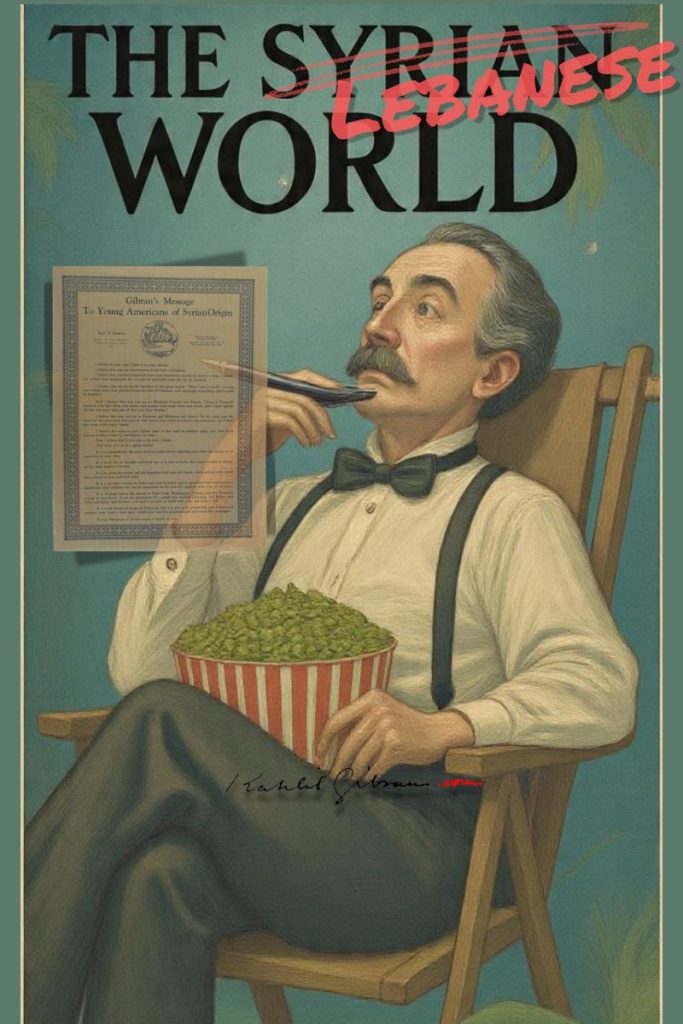
They were not confused. They were navigating a world that had not yet caught up to who they were.
The nation-states that now claim them. Lebanon and Syria, did not exist in the forms we know them when most of these writers were born. Greater Lebanon was proclaimed in 1920. The Syrian Republic came later still. To apply those borders retroactively, as though they were always the truth waiting to be recognised, is to misread history in the service of the present.
And yet, identity is not only paperwork. It is also what a person says about themselves, in their own voice, in their own words, when no one is forcing a category on them. That evidence exists, too. And for Gibran, it points in a direction that no plaque had previously acknowledged.
The complexity is the point
What I hope comes out of this, more than any updated plaque, is a wider recognition that the Mahjar writers were not a monolith. They were a community of extraordinary individuals whose origins, loyalties, and self-understandings overlapped and diverged in ways that defy simple categorisation.
Nasib Arida was from Homs. Mikhail Naimy walked back to Baskinta and lived there until he was 99. Gibran never returned to Bsharri — but his body did. He asked to be buried there. That, too, is a statement.
The Lebanese, Syrian, and broader Arab communities that carry these writers in their cultural memory are not wrong to claim them. They are all, in different ways, right. The question has never been who owns Gibran. The question is whether we are honest enough to hold the full complexity of who he was — and who they all were — without flattening it into something a plaque can contain.
A plaque, by its nature, must be brief. But the conversation around it does not have to be.
A moment worth marking
I founded the Kahlil Gibran Collective because I believed this history deserved rigorous, honest, ongoing documentation. Not advocacy for any government’s position. Not cultural lobbying. Just the work of getting the record right.
This moment — a monument in Lower Manhattan agreeing to reconsider how it names the poets of Little Syria — is the kind of outcome that kind of work is supposed to produce. It does not happen often. When it does, it is worth pausing to recognise what it took: the scholars in Beirut who wrote with urgency, the diplomatic channels that were quietly activated, the Lebanese and Syrian voices alike who refused to let the question go unanswered, and the WSHS, to their credit, for listening.
The wording is still being negotiated as it should be. These things should not be easy.
What matters is that the conversation happened — and that it changed something permanent.
This piece is a follow-up to “Who Gets to Name the Dead? — Gibran, the Mahjar, and the Monument in Manhattan,” published in May 2026.
Glen Kalem-Habib is the founder of the Kahlil Gibran Collective and has spent more than 25 years researching the life, work, and legacy of Kahlil Gibran. Full archive and research at kahlilgibran.com



Glen, Thanks for this clear, well structured, well based and objective article.