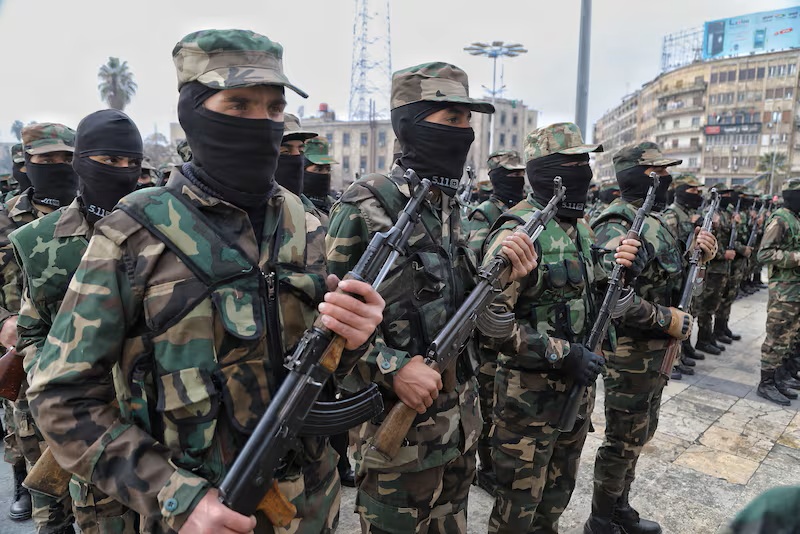
The removal from the Turkish-backed Syrian National Army of Sayf al-Din Bulad, better known as Sayf Abu Bakr, Muhammad al-Jassem (Abu Amsha), and Abu Hatem Shaqra signals a transformation far more consequential than an ordinary reshuffle of the new army. During the war, they commanded powerful factions with their own fighters, networks and sources of influence. After Bashar al-Assad’s fall, those factions were incorporated into the new Syrian military. Incorporation did not necessarily mean subordination. Who controls Syria’s new army?
By Rafic Taleb
The recent restructuring suggests that Damascus is now moving to dismantle the independent power bases of the former factional commanders. Bulad was removed from command of the 76th Division and was reportedly offered a different position within the military hierarchy. He subsequently resigned and travelled to Turkey, where he was reported to have suffered a heart attack before later returning to Syria in good health.
Abu Amsha faced a more serious confrontation. The Ministry of Defence ordered him to transfer commanders from the 62nd Division and redistribute them elsewhere. He resisted, reportedly asserting that his division was outside the ministry’s authority. Damascus responded by preparing to bring the formation under control, ultimately removing Abu Amsha from command and moving him to a deputy corps position. Mukhtar al-Turki was installed in his place.
Shaqra underwent a similar transformation. Rather than being expelled from the military hierarchy, he was moved into a senior deputy position while the forces associated with his former command were reorganised.
The pattern is clear: the commanders are not necessarily being eliminated from the army. Their independent military constituencies are.
That distinction matters because these men were not conventional officers. Their authority was built during the civil war, through factional loyalties and Turkish sponsorship. Their formations were created before the Syrian state could reassert control over the country.
A centralised national army cannot coexist indefinitely with powerful commanders who retain personal authority over armed networks.
The question is why this process is accelerating now. The answer may lie in the changing Turkish-Syrian relationship and, above all, the Kurdish question.
Turkey once needed powerful Syrian proxies. They provided Ankara with military leverage in northern Syria without requiring direct control of every armed group. But the strategic environment has changed. Ankara now has an interest in a stronger Syrian state capable of controlling its territory, absorbing former opposition factions and reaching an enforceable settlement with the Syrian Democratic Forces.
That creates a paradox.
The commanders who were valuable Turkish partners during the war may now be liabilities if they retain independent military power.
A powerful faction leader can serve Turkey's interests when Ankara needs a proxy. He can become an obstacle when Turkey needs Damascus to negotiate and enforce a nationwide security arrangement.
This may explain why the removal of Abu Amsha does not necessarily represent a loss of Turkish influence. His replacement, Mukhtar al-Turki, has been described as a Turkish national and a former HTS commander with connections to Turkey. If those accounts are accurate, the change suggests that Turkish influence may be shifting from autonomous Syrian faction leaders toward the institutions of the Syrian state.
In other words, Ankara may not be abandoning its Syrian clients because it is losing Syria. It may be abandoning some clients because it wants a different kind of Syrian state.
The Kurdish issue makes that transition particularly important.
A durable Damascus-SDF agreement could bring Kurdish forces into the Syrian state while addressing Ankara’s concerns over PKK-linked structures along its border. Turkey has a major strategic interest in preventing the SDF from remaining a permanent autonomous military entity while separating it from the infrastructure associated with the PKK.
For such an agreement to work, however, Damascus needs a military capable of enforcing it. A fragmented army dominated by former factional commanders would make that considerably harder.
This makes the restructuring of the former SNA formations part of the same process as the negotiations with the Kurds. Damascus is attempting to consolidate one armed ecosystem—the Turkish-backed opposition—while preparing to absorb another, the Kurdish-led SDF.
The sequence is therefore significant.
Bulad lost command of the 76th Division. Abu Amsha lost the 62nd Division after resisting the Ministry of Defence. Shaqra was moved away from his former independent military base. Their positions and formations are being redistributed under commanders closer to the central hierarchy.
The objective appears to be less about punishing individual commanders than about removing the factional veto players who could obstruct the creation of a unified army.
This does not mean Syria is becoming free of foreign influence. It may mean that foreign influence is being exercised differently.
The old model was largely:
Turkey → Syrian faction → autonomous commander → armed network.
The emerging model could be:
Turkey → Syrian state institutions → senior military leadership → centralised army.
For Ankara, the second model may ultimately be more useful. It offers less control over individual clients but potentially greater influence over a functioning Syrian state.
The developing relationship between Damascus, the Kurdish leadership and the Kurdistan Region fits this broader realignment. Security arrangements, political concessions, energy agreements and regional diplomacy are increasingly becoming parts of a single settlement in which military control is inseparable from economic and political integration.
That is why the removal of Bulad, Abu Amsha and Shaqra matters. They represent the old factional order: commanders whose power originated outside the state and survived their factions’ incorporation into it. Their decline represents the opposite process.
The Syrian government is attempting to turn former armed movements into state institutions. At the same time, Turkey appears increasingly willing to see its former proxies lose their independent power if that helps produce a centralised Syrian state aligned with Ankara’s broader interests.
The result may be a profound shift in how Turkey operates inside Syria.
Ankara may lose some of its most powerful individual clients while gaining something more valuable: influence within a centralised Syrian military capable of controlling the country, absorbing Kurdish forces and implementing a broader Turkish-Syrian security settlement.
The removal of Bulad, Abu Amsha and Shaqra may therefore mark the end of Syria’s factional military era, not the end of Turkish influence, but the transition from influence through proxies to influence through the state.



[…] all our newspaper’s valiant efforts to predict and expose what’s going on in Syria, I thought it prudent to take a page out of the literary canon to make […]