
Just saw a breathtaking sci-fi movie, Project Hail Mary (2026), and by the creators of The Spider-Verse, no less – Phil Lord and Christopher Miller. The story is from Andy Weir's novel of the same name, and it is hard sci-fi in the extreme, with the sun dying and being eaten alive by space bacteria. The hapless hero here is the last survivor of a space mission, the amnesic schoolteacher Ryland Grace, played quite nicely by Ryan Gosling.
By Emad Aysha
Turns out many suns are dying, except for one, which is why they send the mission to that particular star. I want to say the movie is completely original, but it isn’t. It clearly owes a lot, at least stylistically and in design concepts, to 2001: A Space Odyssey, Silent Running, 2010: The Year We Make Contact, Sunshine, and Ad Astra.
The space suit looks reminiscent of Bowman’s outfit in 2001, while the planetary atmosphere scene is like the Leonov scene in 2010. The immersive hologram room is like Ad Astra, while the gorgeous colour palette is akin to Sunshine and Ad Astra; the lonely guy in space facing the abyss of no one but himself, is like Silent Running.

PRIMAL EXPECTATIONS: A screenshot from 'Ad Astra' (2019) with a crazy baboon taking a bite out of humanity. Does zero gravity mean zero morality?
Even the cute little rock-like alien who helps Grace reminds you of the robot in Silent Running. I suppose I should add Interstellar, with the saving the earth theme and some of the musical tones, along with Pandorum.
The hero there also wakes up from a prolonged deep sleep with amnesia and has to search for himself through flashbacks and moral dilemmas that force him to grow and mature, with us superimposed into his head.
But, apart from that, the movie is original and is a beauty. It’s lavish in its presentation of the spaceship, not to mention the even larger spaceship of the alien race, also trying to save its own star. The super science on display is incredible and downright scary.
The idea that microorganisms can gobble up a star is disturbingly plausible. Ironically, those same bacteria are the fuel for the elongated trip. From the disease comes the cure, as the Islamic saying goes (من الداء دواء).
They consume light and use it to travel across space, harvesting themselves and reproducing in the carbon dioxide atmosphere of Venus. (Interesting choice of planet). Grace was hired to identify the microorganisms and wakes up after 11 years and finds the other two crew members are dead.
Trouble is, he’s no astronaut or engineer. His opposite number on the alien vessel, Rocky, as he calls him, has the same problem. Radiation killed his crew, and he’s a lowly mechanic. By themselves, they can’t figure out the cure to this interstellar illness, but together they figure it out.
The catch is that they have to figure out how to communicate with each other first. Their respective atmospheres are lethal to each other, and both have quirky characters that make it hard for them to tolerate one another.

CAGED HEAT: Meet Rocky, the cutest alien since Spielberg's ET, an entity who risks his non-existent neck to the point that he teaches Ryan Gosling how it isn't brave to be lonely.
Loneliness is the perennial moral theme here. Grace is a loner by nature, too preoccupied with science to hold onto his girlfriend, and he looks on with affection and awe at the astronauts and their respective soul mates.
Human loneliness from each other, at the level of the world governments, is also another clear concern here. Mankind doesn’t cooperate when it comes to scarce resources, food and fuel while Grace is away saving the universe.
By contrast, Rocky’s people mate for life, living for hundreds of years without ever getting bored. Rocky risks his own life to save Grace at one point, and even shares his fuel to help Grace get home on what should be a one-way mission.
He was forced to watch his crew die, and his kind watch each other sleep. Note again the name of the hero, Grace, which is a clear religious allusion. The guy isn’t a believer, to begin with, but trusting in God is what gets them through this. (I should mention that Rocky has 'scratches' on his rocky surface that resemble the Nazca lines!)
Never mind the spaceship itself being called the Project ‘Hail Mary’. But having faith in yourself is the key. Grace doesn’t have it, being someone who gets seasick in an elevator, but by the end, he realises how the crew’s faith in him was well deserved.
You can see more subtle hints of this transformation from the word go. When he wakes up from deep sleep, actually an induced coma, the yellow sleeping sack he’s in has ‘Good luck’ written on it.
Also, when he crawls out of its sticky, wet confines, he’s in another translucent plastic skin. This is meant to replicate birth, with amniotic fluid and sack to boot.
Finding faith amongst the stars is a wonderful contribution to the otherwise cold, harsh world of outer space sci-fi. That might explain why Venus is the planet the microbes multiply on – the planet of ‘love’.
These themes aren’t completely unprecedented in Western screen sci-fi, again with Interstellar and also Red Planet, but still handled wonderfully here. The movie is awash with emotional moments, such as the karaoke scene, the dream sequence, and the holographic room scenes.
The music accentuates it all. The story also wouldn’t work were it not for the incredible special effects, in animated Spider-Verse fashion, specifically for the weird rock-like alien and his glass bubble.
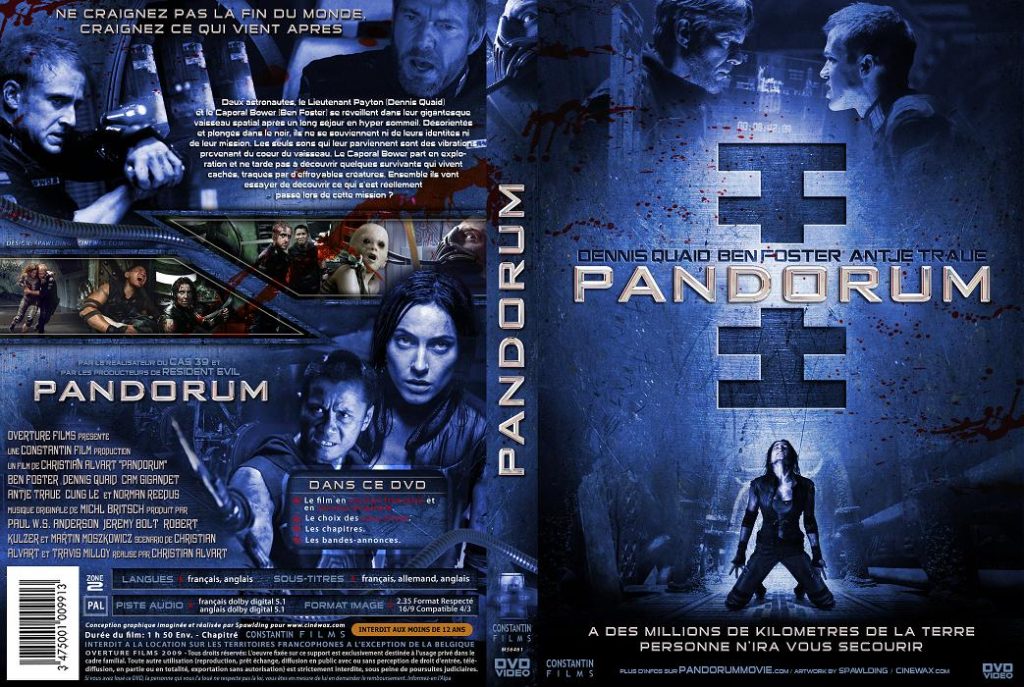
HEARTLESS SPACE: German-led movie 'Pandorum' (2009) about genocidal wars of survival, from earth to the stars. Thank Andy Weir for bucking the Hollywood trend!
He also moves like a chimpanzee, making him more familiar to human audiences on a subliminal level. The colours in the movie operate that way too, such as the green skies of the planet they investigate and the flaming purples when Grace harvests the microbes.
Kudos to the directors for encouraging kids to go into outer space. The children Grace teaches are multiracial, clearly meant to be the future of humankind in toto. (Same as the crew, including Sandra Hüller, Milana Vayntrub and Ken Leung). And space, while a harrowing foreboding place, is made into a place of beauty and wonder here.
The movie is second only to The Martian (Ridley Scott's Andy Weir movie) in optimism and Interstellar in emotion, and both in tension. But it has its own goofy sense of humour to add to the mix and level things out.
Science is the solution when it's marshalled for the good of all – human and extraterrestrial.