I attended a fine seminar lecture the other day by Omar Nasr of the LSE, entitled “British imperial propaganda towards Muslims in the Second World War” (CEDEJ, 9 June 2026). The Germans and Italians also tried to rile up Muslims against the British Empire. Their calls mostly fell on deaf ears, in part because the British had more resources at their disposal – ruling over more Muslims than the Ottomans during WWI. But also in part because their spies, diplomats, Orientalists and BBC radio jockeys were cannier at selecting Muslim go-betweens for the job.
By Emad Aysha
The key, Omar Nasr explained, is to break out of the old way of thinking about propaganda as nothing more than a broadcaster and a receiver of messages. There are intermediaries too, and it’s an interactive process because these go-betweens make demands of the imperialist broadcaster. This takes us another step away from Edward Said’s Orientalism, with the Orientalists being all bad and the targets of Western imperialism being all good.
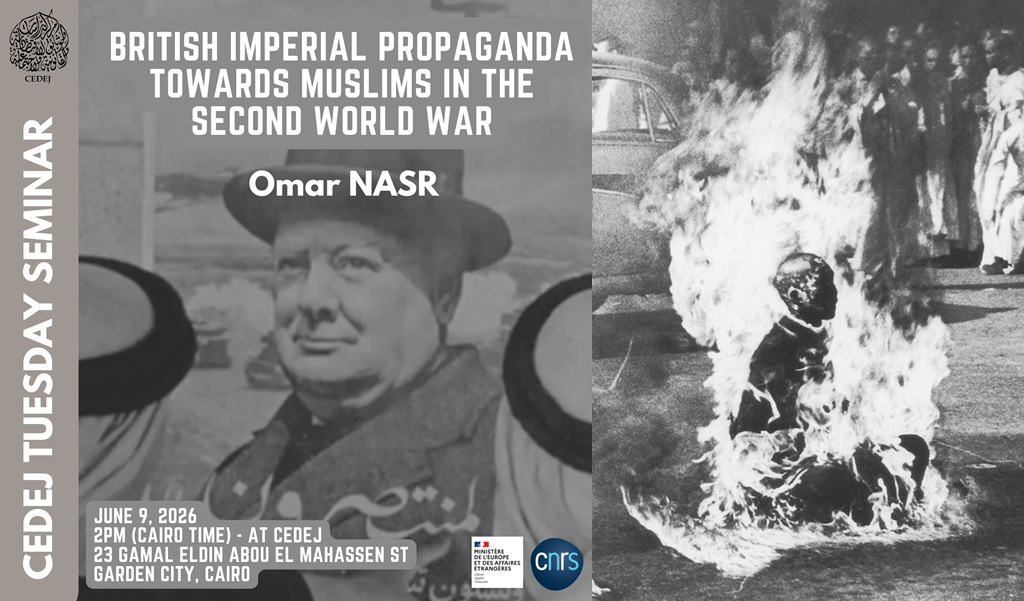
BRIT POP APPEAL: British imperialist propaganda [CEDEJ flier] would have hit a brick wall in a country like Vietnam. Their brand of cleric, like Buddhist monk Thich Quang Duc, would rather set themselves ablaze than collaborate.
Some Orientalists genuinely liked the Arab world and were trying to help, while others were capricious liars. Nonetheless, the real culprits were the so-called Islamic fundamentalists and sectarians; fence-sitters waiting to see how the wind would blow.
Check out parallels with Palestine 36 (2025), reviewed here before. With nice-guy Brits being ostracised while so-called Islamists were working as secret stoolpigeons for the imperialists and Zionists.
Typically for me, I used a pop culture reference, citing A.J. Quinnell’s espionage thriller The Mahdi (1981), where an old British spymaster tells the Americans to create a religious miracle, a Mahdi. This will unite the Muslim world against the Soviets.
MI6 are given the job, and they (very cunningly) spread the rumour of a coming Mahdi in Indonesia, the most populous Muslim country in the world. It typically travels westwards through the Hajj till it reaches Mecca.
That is quite close to what the British did, in fact, having special committees to spread rumours in far-off India and hoping dearly that the rumours would take on a life of their own, to cite Nasr. And typically they saw the Middle East as the nerve centre of Islam.
Nasr himself cited the similarly themed WWI novel Greenmantle (1916) by John Buchan, the author of the legendary The Thirty-Nine Steps. Quinnell was responsible for the Creasy series.
This point is all that got me thinking about a particularly pungent American pulp novel, Assignment Burma Girl (1961), by Edward S. Aarons. Here, a CIA man is sent into the jungles of Burma in search of the enigmatic leader of the Communist mountain insurgency.
He disappears, and they send another guy in. He succeeds but in the most obsequious way possible. He goes to bars to look up contacts and charters a flight illegally. (The Burmese government won’t let American officials trespass on their sovereignty. Hah!)
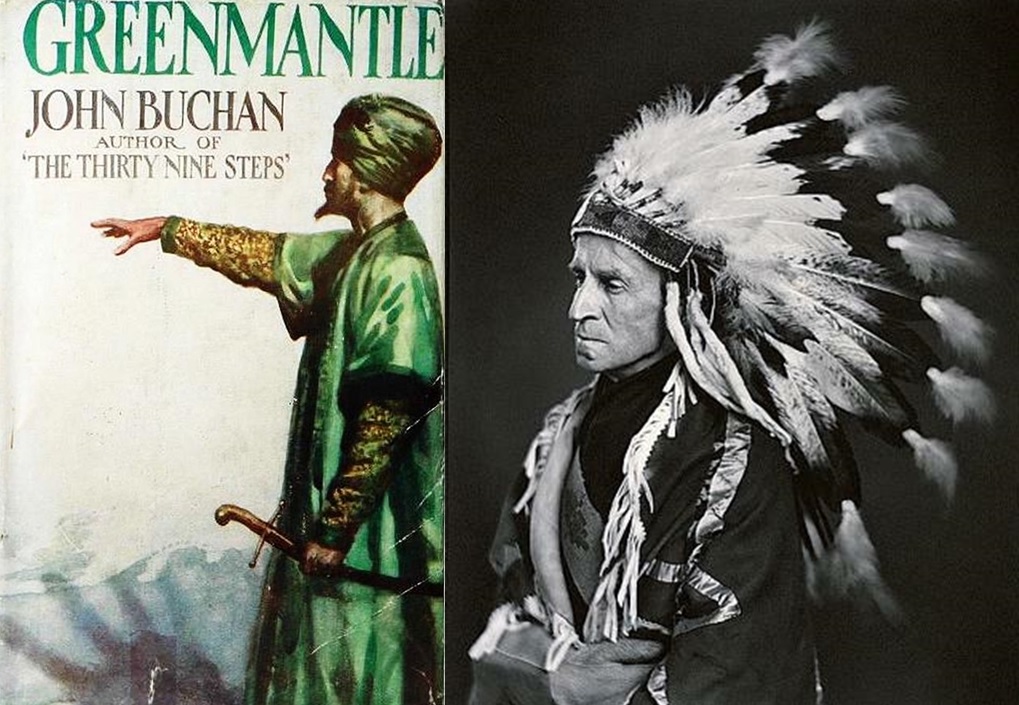
WILD AT HEART: An actual photograph of John Buchan [right] from www.nationalgalleries.org. He was a British colonial official (Africa, Canada) who clearly preferred the pen of persuasion to the sword of coercion.
He encounters the rebel leader only to discover he’s an American commando left for dead during WWII, turning to Communism out of anger because his side forgot about him. When the secret agent man escapes, however, he feels lost in the big bad jungle, reminding him of his childhood in New Orleans, when he got lost in the swamp.
The novel practically predicted the predicament the Americans got themselves into in Vietnam. A war led by CIA desk jockeys.
Moreover, the Americans get into Burma because they misperceive Chinese propaganda as expansionism. A ‘land grab’, as they put it, something Americans do and assume everybody else is like them.
The novel also illuminates the weird role of religion in the actual Vietnam conflict. A former Japanese prison guard spared the American commando’s life, as a good Buddhist, but now regrets this fateful decision.
There’s also some Burmese commander dude the CIA guy talks to who refuses to engage the communist insurgent up in the hills and forests, again because of his peacenik Buddhist credentials. The agency man says you’re just scared and all that’s needed to win is to show some gumption in battle.
The commander guy responds and, magically, he wins. He wins while fighting a carefully hidden enemy, in a dense tropical forest. And with the advantage of the high ground, so they can see everything going on downhill!
Americans clearly don’t believe in peace and see such beliefs as cowardice or lack of confidence. One of the American contacts working for the hero is a miserable, decaying person desperate for a mission.
Check out any (stupid) American Vietnam movie you like, and you’ll find some bartender guy who is sick of the soft life. (Watch Gene Hackman’s Uncommon Valour [1983].)
That, finally, explains what happened in Vietnam with the Buddhist monks and Diem, with them setting themselves on fire in protest. The (Catholic) despot most likely was trying to get them to mobilise people for the war effort, and they gave him a stout no!
So much for the US wanting Muslims to undergo a Reformation of their religion, post-9/11. If Muslims believed in peace, during the Cold War, the Yanks would have called them collaborators. (How ironic that a Commie assassin in the novel smokes Hashish!)
Well, at least the Buddhist priests weren’t content to be stoolpigeons, wanting to keep the country united against sectarian and ethnic infighting. That’s a lot more than I can say for our clergy; today, yesterday or tomorrow.
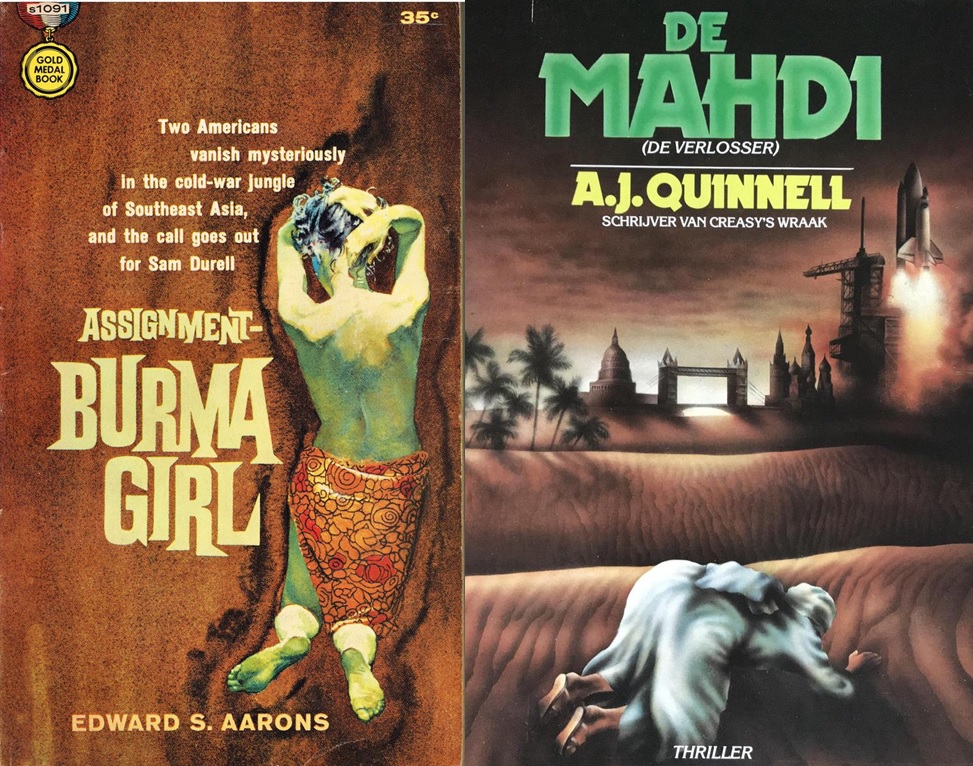
PULPY PROPHECIES: The two infamous novels analysed here, revealing more than they should about the ultimate Cold War target - the Western voter!
Oh, the novel also thinks that the Americans wrote the rulebook on wars behind enemy lines. The bad guy uses the standard techniques they had during WWII, with no modifications. No wonder the Yanks didn’t anticipate the Viet Kong building tunnels and entire bases underground.
They even discarded the original workbook for counter-insurgency written by the Brits in Malaya, fighting communists. The local-needs approach, why the Communists won in the South with the peasants and neglected northern refugees in the cities.
Did I mention that The Mahdi is practically science fiction? They have to use lasers fired from outer space to create the miracle, in Mecca at the peak of the Hajj. Next time it’ll be Arrakis in Dune Messiah.
Where’s a Zensunni monk when you need him?!!