What is unfolding in Syria today can be most accurately understood not as a conventional political transition, but as the gradual emergence of a military-centred state apparatus—one in which the army, rather than civilian institutions, forms the backbone of governance, legitimacy, and geopolitical negotiation. Under Ahmad al-Sharaà’s administration, the Syrian military is no longer simply a security instrument; it has become the primary vehicle through which political authority is organised, distributed, and contested.
By Rafic Taleb
The restructuring of armed factions into a unified military framework lies at the core of this transformation. On the surface, this process resembles state-building: the integration of disparate militias into formal divisions, the establishment of command hierarchies, and the creation of what appears to be a national army.
Yet the internal reality tells a more complex story. While the army’s composition remains broad—incorporating fighters from multiple factions—the command structure is increasingly centralised, with real authority concentrated within a narrow leadership circle aligned with al-Sharaà.
This produces a distinctly hybrid military institution: expansive in manpower but tightly controlled in decision-making. Autonomy among units exists largely in form rather than in substance. Loyal cadres are embedded across divisions, ensuring that operational authority ultimately flows upward through trusted channels.
In this sense, the Syrian military is evolving less into a neutral national force and more into a vertically integrated power system—one that retains the logic of factional dominance while adopting the outward appearance of statehood.
This militarised structure extends directly into the political sphere. The emerging parliamentary and administrative bodies do not function independently of the military order; rather, they are shaped by it. Representation, appointments, and decision-making processes reflect the same centralised logic found in the armed forces.
Political institutions, in effect, serve to formalise and legitimise a reality already established through military consolidation. Legitimacy is therefore constructed from the top down, rather than negotiated from the bottom up.
At the same time, the evolution of the Syrian military cannot be separated from the influence of external actors. The United States, the United Arab Emirates, and France are each playing distinct roles in shaping this emerging order—engaging not simply with a government, but with a military-political structure that increasingly defines the Syrian state itself.
The United States approaches Syria through a lens of strategic containment and risk management. Its engagement with the Syrian military structure reflects broader objectives: preventing instability from spreading across the region, limiting the resurgence of transnational extremist threats, and maintaining a controlled balance of power.
Within this framework, al-Sharaà’s military consolidation is tolerated—if not quietly facilitated—so long as it aligns with these priorities. Force composition, integration processes, and internal balances are therefore not purely domestic matters; wider American security calculations also shape them.
The United Arab Emirates’ role is more direct, particularly in the military and security domains. Its involvement reflects an attempt to reshape Syria’s armed forces into a model consistent with Abu Dhabi’s broader regional doctrine: centralised authority, disciplined security institutions, and the containment of ideological militancy. By engaging with the Syrian military as an institution, the UAE is not merely supporting stability—it is influencing the very nature of that stability, steering Syria toward a controlled and highly centralised security order.
France, meanwhile, operates at the intersection of political engagement and strategic positioning. This role has become increasingly visible through President Emmanuel Macron’s recent visit to meet Ahmad al-Sharaà. The visit carries significance beyond diplomatic symbolism; it represents France’s willingness to engage directly with the military-backed political order now taking shape in Damascus.
Paris’s approach appears to follow a dual strategy: first, to influence the direction of Syria’s political transition; and second, to secure a long-term role in reconstruction, infrastructure, and energy opportunities. Macron’s engagement signals that France recognises the central role of the Syrian military apparatus in governing the country while seeking to shape the country's future trajectory.
France appears positioned as the political face of Western engagement, complementing the United States’ more security-focused role. By engaging with al-Sharaà at this stage, Paris is effectively acknowledging that the military structure is now central to Syria’s governance while seeking to influence the terms on which this new order develops.
These external influences converge within a political environment in which the Syrian military serves as both the gatekeeper and the guarantor of the emerging state. Al-Sharaà’s administration must therefore navigate a difficult balance: internally, maintaining cohesion among its military base while preventing fragmentation; externally, projecting enough pragmatism and stability to remain acceptable to international partners.
This balancing act reinforces the centrality of the military. It is the institution through which domestic control, political legitimacy, and international engagement are managed.
Yet beneath this structured surface, major challenges remain. Governance continues to face economic pressure, corruption allegations, institutional weakness, and regional disparities that undermine public confidence. The militarisation of authority has not resolved these problems; in some cases, it has intensified them by prioritising control and loyalty over transparency and accountability.
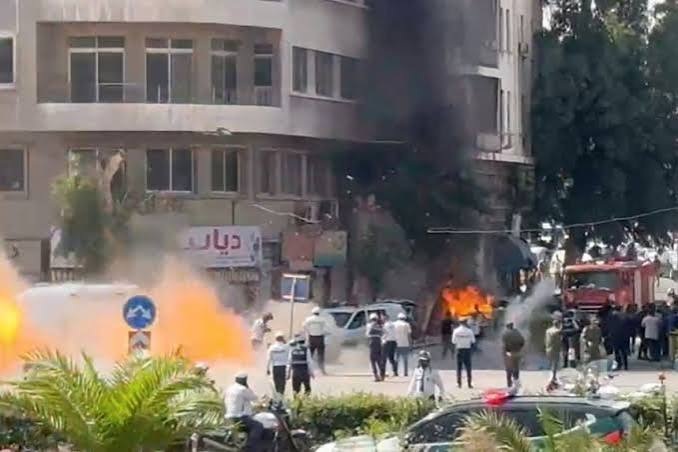
Security remains equally fragile. Despite the appearance of consolidation, the Syrian military has not achieved a monopoly over force. Competing actors, fragmented intelligence networks, and continued security incidents reveal the limits of central authority. Reports of overlapping security institutions and coordination failures demonstrate that Syria, despite its increasingly militarised structure, has not yet achieved full sovereignty.
This reality places Syria within a broader geopolitical struggle. The country is no longer merely rebuilding after years of conflict—it is being reconfigured as a strategic arena within a larger regional and international competition. Foreign powers are not simply engaging with a government; they are engaging with a military architecture that both enables and restricts political outcomes.
Every internal decision carries international consequences, and every external intervention reshapes Syria’s internal balance.
The Syrian military, therefore, is no longer merely a national defence institution—it has become the defining structure of the Syrian state itself. Its evolution will determine whether Syria moves toward durable stability or remains trapped in a cycle of managed uncertainty.
The central question is no longer whether the military can consolidate power—it already has. The question is whether that power can be transformed into genuine political legitimacy.
For now, Syria remains suspended in a state of controlled ambiguity: a country where the military builds the state, the state legitimises the military, and both are shaped by forces extending far beyond its borders.