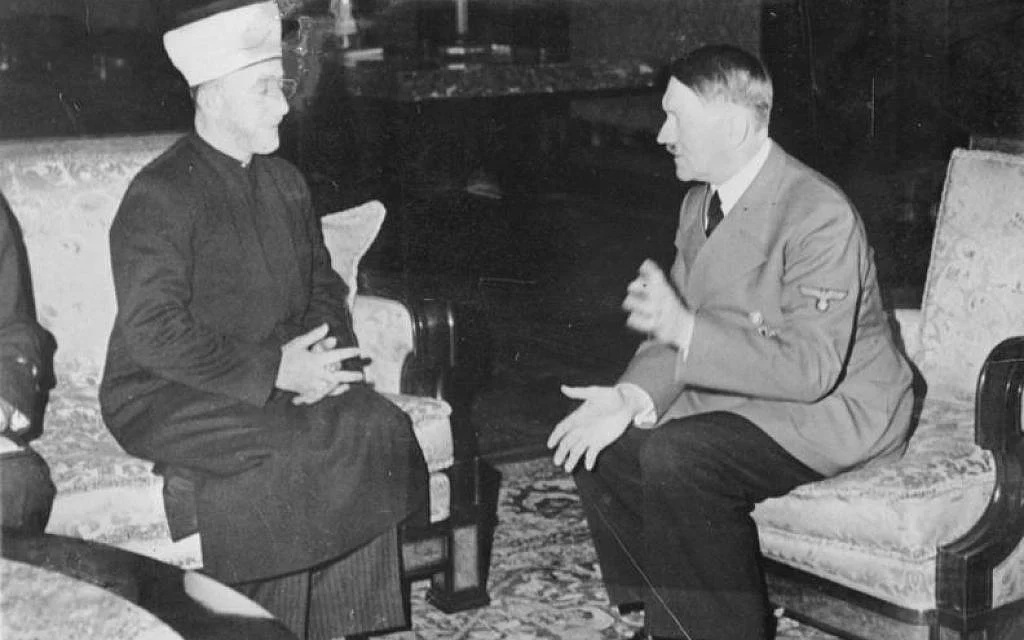
Adolf Hitler was born in 1889. This means that the context in which he grew up was still closely linked to the original meanings of "left" and "right." This classification dates back to the French Revolution, when the king's conservative allies sat close to the monarch in parliament. Those favouring change, who demanded greater rights for the citizenry, sat on the left side of the chamber.
Read part 1 of this two-part series here
This political landscape, characterised by a clash between conservative monarchies and republican forces, shaped the Europe in which Hitler grew up.
And although Hitler secured absolute power in Germany in 1933, he made no move whatsoever to reinstate the deposed emperor. This was entirely feasible, given that the former German emperor resided in the Netherlands from 1918 (the end of the First World War) until he died in 1941.
Someone who was truly right-wing to the core—and who had come of age during that same period—would have attempted to restore the monarchy. Hitler was a military man who explicitly refrained from doing so. In contrast, right-wing military figures in Russia—such as Fedor Keller and Lavr Kornilov—did attempt to restore the monarchy.
Upheaval and urbanizatio
It is worth noting that this political landscape bore a close resemblance to the conditions described by the socialist founding father Karl Marx (1818–1883). Marx, for instance, had fiercely criticised the economic monopolies held by the Crown. The Nazis had every opportunity to restore the monarchy, just as the French had restored theirs following the Congress of Vienna (1815).
Yet, as mentioned, no such move was ever made; consequently, National Socialism existed primarily as a continuation of the socialist, republican, and nationalist upheavals set in motion alongside the rise of Marxism.
Although its imagery alluded to Wagner, as well as to rural life and folk traditions, National Socialism was not, in essence, a conservative force. On the contrary, it was a force that emerged as a direct consequence of urbanisation, industrialisation, and the waning influence of monarchist forces in rural areas—a movement characterised by migration to major cities and the erosion of traditional social circles and ties.
This aspect is precisely what attracted a displaced technocrat like Albert Speer to National Socialism: the decline of traditional authorities created a vacuum in which a new, totalitarian form of expertise could emerge.
The Nazi policy of *Gleichschaltung* (forced coordination) was the final move to detach the individual from traditional, conservative ties and subsequently absorb them into a collective, totalitarian "people's community" (*Volksgemeinschaft*).
Although Nazi imagery and political promises suggested otherwise, the nation—as a body of cultural traditions and organic bonds—was made subordinate to the state in a totalitarian manner.
The Austro-Hungarian Monarchy
Returning to the ultimate argument for why Hitler was a leftist politician: in the context of his upbringing, "Right" signified loyalty to the king and emperor, whereas "Left" stood for republicanism and rebellion. His own political career—and the very reason he had become involved in politics in the first place—stemmed from his aversion to the Austrian monarchy.
During Hitler’s formative years (he was born in 1889), the state consisted of Austria-Hungary, a vast multinational monarchy ruled by Emperor Franz Joseph I. That empire encompassed, among others, German-speaking Austrians, Hungarians, Czechs, Slovaks, Slovenes, Croats, Serbs, Romanians, and Italians. None of these groups constituted a majority; consequently, the empire was organised not around a single nation, but around the imperial dynasty.
A dynasty in decline
The prevailing idea was that the emperor held the empire together, yet this succeeded only as long as the emperor remained strong. From the late nineteenth century onwards, nationalism gained momentum. Almost every ethnic group demanded greater autonomy or even a state of its own. In his book *Mein Kampf* (1923), Hitler describes how the monarchy attempted to force a variety of peoples—who were fundamentally incompatible—into a single, restrictive framework.
The solution he advocated for this reason was not the reform of the monarchy, but Austria’s union with Germany (the *Anschluss*). His aversion to Austria’s monarchs was, in fact, a reason for him—an Austrian—to enlist in the German army.
He also admired the German-nationalist politician Georg von Schönerer, whom he explicitly cited as a role model and source of inspiration. Schönerer was fiercely opposed to the Habsburg monarchy and advocated for the German-speaking territories to join Germany.
When war broke out in 1914, he volunteered for the Bavarian army, part of the German military, a highly significant move: although legally an Austrian citizen, he wished to fight for Germany rather than Austria-Hungary.
A purified, engineered society
Hitler rejected the Austro-Hungarian monarchy, viewing it as an artificial, multinational state that obstructed the German national unity of which he considered himself a part. The Third Reich, which he subsequently built himself, also encompassed various nationalities and peoples, but these were now clearly placed under German command. This racial principle differed radically from the dynastic concept underpinning the conservative monarchies that had existed until then.
For Hitler, the totalitarian ideal of a purified, engineered society thus took precedence over traditions, ancient royal houses, and local regions with their specific privileges.
Ultimately, Hitler’s political evolution demonstrates that National Socialism was not a restorationist movement (as the ‘progressive Left’ invariably claims), but a revolutionary project. It rejected the dynastic legitimacy of the old European monarchies, replacing it with a totalitarian state in which race, party, and leader took the place of king, church, and regional traditions. It was precisely in this regard that the true break with the old, conservative Europe lay.
Comintern tactics
Moreover, it was a deliberate strategy of the Comintern—the international alliance of socialists and communists under Russian leadership—to stop speaking of "National Socialism" altogether and refer exclusively to "fascism" (a term that pointed far more to Mussolini and Italy than to Hitler’s Germany). This approach gained traction because it served several purposes:
[1] It allowed fascism to be characterised as a "right-wing" force—a useful tactic in many political campaigns. The socialist element of Nazism was opportunistically downplayed.
[2] The similarities between communism and the Nazi system could more easily be swept under the rug.
[3] Nazism became a broader phenomenon: Italians and other fascist groups (such as the Spanish Falange) were now subsumed under this same movement. By speaking of "fascism" rather than "National Socialism," the burden of guilt was diluted, meaning it no longer rested solely on Germany.
Taken together, the evidence shows that while Hitler presented himself as a defender of tradition, he definitively replaced the old monarchical order with a new, totalitarian state order.
For this reason, National Socialism aligns more closely with the revolutionary nineteenth century (and thus with the Left) than with the *Ancien Régime* (and thus with the Right).
In short: Adolf Hitler was a leftist politician. This has now been conclusively proven.
Sid Lukkassen is currently working on an epic project titled *Zin in Chaos* (Finding Meaning in Chaos), which aims to discover meaning in an era of decline and a drive for control. He is writing a book and raising funds to publish and launch it through a magnificent, grand, and unifying event. He explores the ideas of both ancient and modern philosophers to find a sense of grounding in turbulent times. Watch the video and support the project.
Read part 1 of this two-part series here