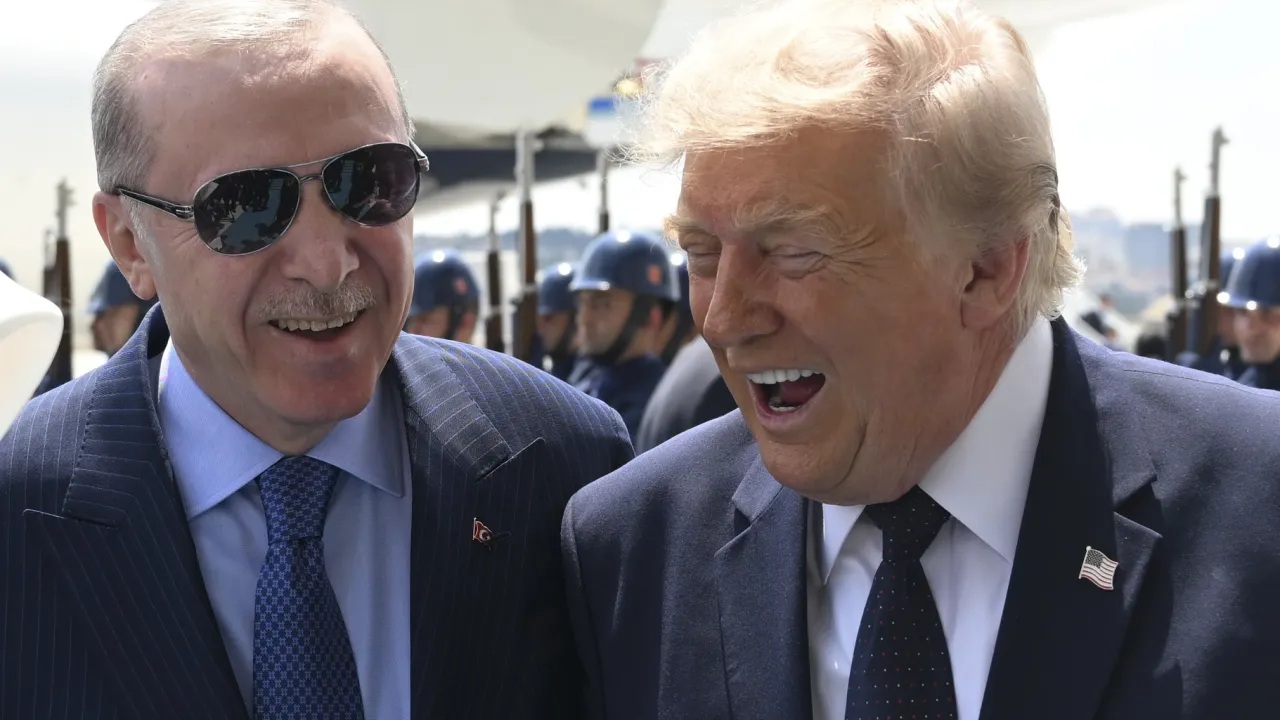
As Donald Trump arrived in Ankara this week to reset relations with Turkey, the visit immediately raised questions extending far beyond NATO diplomacy. At a moment when the Middle East is being reshaped by Iran’s weakening and Syria’s uncertain future, Washington’s renewed engagement with Ankara is being watched closely in Jerusalem.
By Nadia Ahmad
For Israel, the issue is not only the future of American-Turkish relations. It is whether Turkey’s growing influence near Israel’s northern frontier will become one of the defining security questions of the post-Iran Middle East.
The Middle East is not entering an era of stability. It is entering a period of major change under conditions that remain unstable, divided, and difficult to predict. What is emerging after Iran's weakening is not a new balance but a struggle among several powers to shape the region simultaneously.
This shift is already visible along Israel’s northern border. The weakening of Iran has not removed tension from the region. It has changed its form. And in this new reality, Turkey has moved into a far more sensitive position than it occupied a decade ago.
For Israel, this does not replace the Iranian challenge, but it creates a different and more complicated security problem. The region is no longer defined by one main confrontation. Instead, Israel now faces a situation in which Turkish influence in Syria, political networks among fragmented Sunni communities, and Ankara’s growing regional ambitions are creating a new set of challenges.
For years, regional politics revolved around Iran as the main force behind instability. Through proxy groups, militias, and indirect warfare, Tehran shaped events across Lebanon, Syria, Iraq, and beyond. That system created a clear pattern of confrontation. Countries understood the logic of escalation and deterrence.
That clarity is now fading. Iran remains an important regional actor, but sanctions, economic pressure, internal difficulties, and years of strategic overextension have weakened its ability to project power.
The result is not peace, but competition. Several regional powers are now trying to expand their influence in an environment where old limits have become weaker.
Turkey has been one of the most active players in this new reality. Under President Recep Tayyip Erdoğan, Ankara has moved beyond the role of a country simply protecting its borders. It has increasingly sought to shape events across Syria, Iraq, the Eastern Mediterranean, and other areas where traditional power structures have weakened.
This is most visible in Syria. What began as a security operation connected to border concerns and Kurdish militancy has developed into a long-term Turkish presence in northern Syria. Turkish forces, allied groups, local political structures, and security arrangements have created an influence that is unlikely to disappear quickly.
From Israeli and European perspectives, the key question is not only what Turkey says it wants, but also what its presence creates on the ground.
Syria today remains deeply divided. Different powers continue to compete for influence inside the country. Russia maintains interests. Iranian-linked networks remain active despite setbacks. Kurdish forces control areas in the northeast. The United States maintains a limited role. Israel carries out operations in accordance with its security needs. And Turkey has built a strong position in the north.
This is not a settled situation. It is a situation in which several competing interests coexist, creating constant tension.
From Israel’s perspective, the main concern is not necessarily open hostility, but the challenge created by a powerful neighbour expanding its influence closer to Israel’s borders. Israeli security thinking has traditionally relied on clear threats and defined lines of deterrence. Turkey’s approach is different. It often relies on political influence, local partnerships, economic links, and the gradual expansion of its role in neighbouring areas.
This difference is significant, as Turkey’s position differs from Iran’s in often-overlooked ways. Iran built much of its regional influence through armed groups and networks operating outside traditional state structures. Turkey, however, remains a NATO member, maintains important economic ties with Europe, and remains connected to Western institutions while pursuing an independent foreign policy.
This creates a difficult balance. Turkey is not a traditional enemy of the West, but it is also not always aligned with Western priorities. For many European policymakers, Ankara has become a challenging partner whose regional decisions sometimes create uncertainty.
Nowhere is this clearer than in Syria, where Turkish influence intersects with a country still struggling to rebuild after years of war. The concern is not only military positions, but also the political forces and alliances that may emerge in areas where outside powers have gained influence.
This is where the question of minorities becomes important.
For decades, the Syrian state under Bashar al-Assad presented itself as a system built around state control and the protection of different communities. With that order weakened, fears have returned among Christians, Druze, Alawites, Kurds, and other minorities that have historically depended on the state or external guarantees for security.
In this environment, Turkey’s role is viewed with caution by many observers. Ankara’s domestic politics are shaped by strong nationalism and an unresolved Kurdish issue. Its involvement in Syria has also included cooperation with various Sunni factions that emerged during the civil war.
This does not automatically determine the future. But in the Middle East, perceptions often become part of the political reality itself.
At the same time, Arab countries are adjusting their own strategies. Saudi Arabia and the United Arab Emirates are increasingly focused on economic development, internal transformation, and reducing regional tensions. Within this approach, both Iranian and Turkish ambitions are carefully examined, though for different reasons.
Iran is still seen mainly as a direct security challenge. Turkey is viewed as a more complicated actor: a country with major influence, strong ambitions, and the ability to shape events in fragile areas.
The region is therefore not separating into simple alliances. Instead, countries are trying to protect their interests while maintaining relationships with several competing powers. Turkey benefits from this situation, but it also faces serious limits.
Its influence now extends across Syria, Iraq, Libya, the Caucasus, and parts of Africa. However, maintaining such a wide regional role requires economic strength and political stability. Currency problems, domestic divisions, and economic pressures limit Ankara’s ability to transform influence into permanent control. This creates a gap between Turkey’s ambitions and its capabilities.
For Europe, this question is especially important. Turkey remains part of NATO, but its independent regional policies have raised questions about how closely Ankara’s future direction will match Western interests.
Trump’s visit to Ankara therefore carries significance beyond a simple diplomatic meeting. It may represent an American attempt to manage a new reality in the Middle East after Iran’s weakening.
After confronting Iran’s regional influence, Washington now faces another challenge: keeping Turkey aligned with the Western camp while preventing new tensions from developing among major regional players.
For Washington, improving relations with Ankara is not only about repairing a difficult partnership. It is also about keeping Turkey firmly connected to NATO and reducing the possibility of a deeper strategic relationship between Ankara and Moscow.
Turkey has always tried to balance between the East and the West. It has maintained relations with Russia while remaining part of the Western alliance system. The question facing Washington is whether renewed engagement can encourage Turkey to place greater emphasis on its role as a Western partner while limiting areas of disagreement.
For Israel, however, the Turkish-American relationship will be viewed through a different perspective.
Relations between Ankara and Jerusalem have deteriorated sharply since the Gaza war. President Erdoğan’s criticism of Israel has created one of the deepest diplomatic crises between the two countries in recent years. At the same time, Turkey’s expanding role in post-Assad Syria has increased Israeli attention toward Ankara’s regional ambitions.
The issue for Jerusalem is not whether Washington should maintain relations with Turkey. Turkey remains a major regional power and an important NATO member. The question is whether closer American-Turkish ties will also encourage a more restrained Turkish approach toward Israel and toward Syria, where decisions made today could shape the security environment of tomorrow.
Trump’s visit is therefore likely to be watched carefully in Jerusalem. Any new understanding between Washington and Ankara will be measured not only by diplomatic achievements but also by its contribution to a more predictable region.
The challenge for the United States is becoming increasingly complex. Washington wants to prevent Iran from rebuilding its former network of influence, maintain stability among its partners, and avoid allowing new rivalries to replace old ones.
The weakening of Iran has therefore not made the Middle East simpler. It has opened the door to a new competition between several powers, each trying to protect its own interests.
Turkey, Israel, the Gulf states, Iran in its reduced form, Russia, and the United States all remain involved in shaping the future of the region. No single actor controls the outcome.
Turkey’s position near Israel’s northern frontier should therefore be understood as a long-term development rather than an immediate confrontation. Ankara’s influence in Syria and its wider regional ambitions represent a new factor that Israel, Europe, and the United States will have to manage carefully.
The Middle East, after Iran, is not becoming more peaceful simply because one major actor has been weakened. Instead, a new struggle for influence is emerging. More powers are competing for space. More interests are crossing each other. And decisions made in Ankara, Washington, Moscow, and Jerusalem will increasingly affect one another.
In this new Middle East, geography remains decisive. When rival ambitions converge, the possibility of tension increases. Turkey’s role near Israel’s border is therefore not just another regional development. It is part of a larger transformation that will shape the future balance of power across the Levant.






This is an exception article which I've read and re-read several times.
This is an exceptional article which I've read and re-read several times.