Ernesto “Che” Guevara returns briefly from the dead every October. The anniversary of his execution (9 October ’67) revives the familiar photographs, the revolutionary slogans, the image of the bearded guerrilla transformed into a secular saint. It also revives questions about his death: what happened in the hours before he was shot, why the Bolivian authorities gave conflicting accounts, and how his death in the Bolivian countryside became one of the most recognisable political images of the twentieth century.
By Rami Audi
Not all questions are equally credible, and not every suspicion deserves belief. Yet the story's persistence reveals something more interesting than the usual argument between conspiracy believers and their sceptics. It reveals a struggle over who has the authority to define reality.
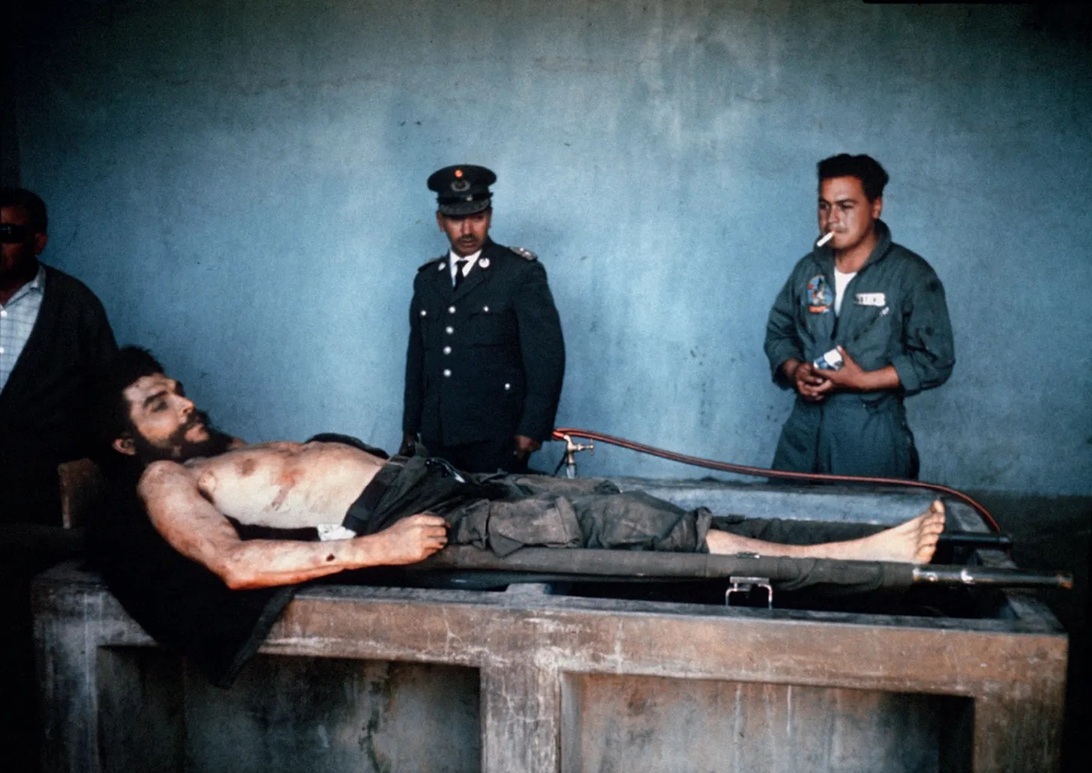
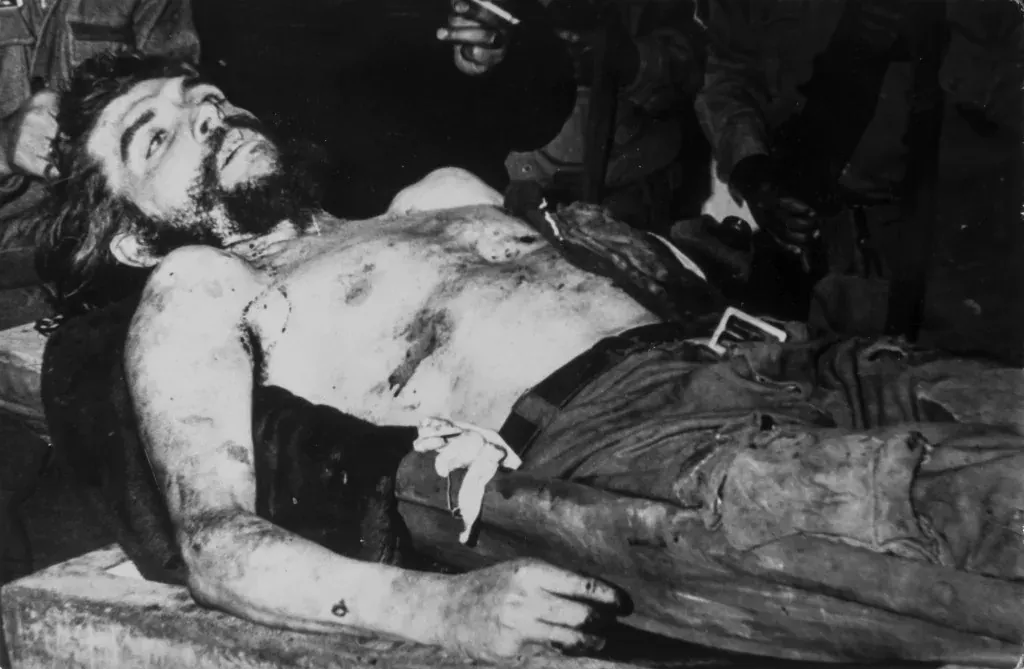
Guevara was captured by Bolivian forces on 8 October and executed the following day. His body was displayed before journalists in Vallegrande, where Freddy Alborta photographed the dead revolutionary lying on a concrete slab, his eyes open and his long hair framing his face. The image travelled around the world. Observers saw echoes of religious paintings, particularly the dead Christ.
The resemblance was visual, but its political consequences were immense. A defeated guerrilla could now be remembered as a martyr; a revolutionary whose campaign had failed could acquire a kind of immortality that military victory might never have secured.
Genuine uncertainties surrounded the final hours. Official statements initially suggested that Guevara had died from wounds sustained in combat, while declassified American records later documented the conclusion that he had been captured and deliberately executed.
The Bolivian authorities also concealed the location of his burial, and his remains were not identified and recovered until 1997. These were not inventions of conspiracy theorists. They were real circumstances that made speculation possible. But the existence of unanswered questions does not prove every theory subsequently built around them.
That distinction matters, because the history of Guevara’s death offers a case study in how facts, secrecy, political interest and myth can become entangled.
The first transformation was not performed by liberalism. It began within the revolutionary world that Guevara helped create. Communism had long understood that political movements require more than programmes and armies. They require symbols of sacrifice, exemplary lives and stories through which defeat can be converted into moral victory.
Guevara’s death offered an almost perfect narrative. The revolutionary had entered the wilderness, fought an unequal battle, been captured by his enemies and died far from the capital of the revolution he had helped bring to power.
His failure in Bolivia could be reinterpreted as proof of his devotion. Death removed the possibility of further political disappointment and left behind an image that could be endlessly reproduced.
Fidel Castro’s Cuba had every reason to preserve that image. Guevara’s fate could indict American power, inspire revolutionary movements, and remind people that the struggle was larger than any one campaign. The dead man could be made to speak for the living.
His face became a portable political message, detached from the complexities of his career and carried into places he had never visited. The photograph no longer needed to explain what Guevara had done, what he believed, or what kind of government he wished to establish. Recognition itself became a form of assent.
Yet the communist movement alone cannot explain the extraordinary reach of the Guevara image. A revolutionary icon travelled into Western universities, fashion, advertising, popular music and the broader culture of youthful rebellion.
The same face that represented armed Marxist revolution could decorate a T-shirt worn by someone with little interest in Marxism. The symbol crossed ideological borders, sometimes carrying its original message and sometimes shedding it almost completely.
This is where the liberal cultural world enters the story. Its contribution was different from that of the communist movement, and there is no need to imagine a secret agreement between them. Revolutionary organisations had reasons to cultivate a martyr. Artists, publishers, journalists, cultural institutions and commercial enterprises had other reasons to circulate a compelling image.
Some admired Guevara’s opposition to imperial power. Others were drawn to the romance of rebellion, the drama of a young revolutionary’s death, or the commercial value of an instantly recognisable face. These motives were not identical. Yet their effects could reinforce one another.
The result was a curious convergence. Communism supplied the martyr narrative; elements of Western liberal culture supplied new audiences, new meanings and new markets. One side could celebrate the revolutionary as a fallen soldier in an unfinished struggle. Another could admire him as a universal rebel against authority.
These readings often left their contradictions unexplored. Guevara’s record as a committed Marxist, his role in revolutionary violence and his association with a political system that did not embody liberal freedoms could recede behind the more attractive image of defiance.
The word *conspiracy* is tempting here, but it must be handled carefully. A conspiracy ordinarily implies a concealed agreement among people who intend to achieve a particular result. We need not invent such an agreement to explain Guevara’s cultural afterlife.
What deserves scrutiny is a different phenomenon: the convergence of interests through which a political myth is made, circulated and protected from inconvenient questions. A revolutionary government, a Western cultural industry, and an advertising company need not share a philosophy to profit from the same image. They need only find different uses for it.
This raises a question that liberal societies do not always welcome. Who decides when suspicion is reasonable and when it becomes conspiracy thinking? The philosopher Karl Popper warned against society's conspiracy theory: the assumption that major social events are deliberately arranged by powerful individuals or groups pursuing a unified design.
His warning remains valuable. History is rarely the product of a single hand controlling every outcome. Institutions collide, officials make mistakes, incentives produce unintended consequences, and events acquire meanings no participant could have anticipated.
But Popper’s warning can be misused if it becomes a convenient way to dismiss every inquiry into concealed power. Actual conspiracies have existed. Governments have hidden operations, intelligence agencies have conducted secret interventions, political organisations have coordinated their activities, and officials have sometimes offered public explanations designed to conceal what they knew.
The history of Guevara’s execution itself demonstrates why official statements should be tested against documentary evidence rather than accepted merely because they are official.
The serious question, therefore, is not whether one should believe conspiracy theories or reject them all. It is how a society distinguishes an evidence-supported claim from a story sustained by suspicion alone. The answer cannot depend exclusively on the social standing of the person making the claim.
A hypothesis does not become false because its author is an outsider, nor does it become true because it challenges an establishment. Evidence must carry the burden that identity and reputation cannot.
Liberalism has a particular stake in this problem because it presents itself as a system in which power is dispersed, authority is contestable and public debate can correct official error. In principle, this is a powerful defence against the manufacture of political truth. In practice, however, formal freedom does not eliminate informal influence.
Governments, financial interests, media organisations, universities, professional networks and cultural institutions can shape which questions receive attention, which interpretations gain prestige and which claims are dismissed before they are properly examined.
No single centre needs to control these institutions. Shared assumptions, professional incentives and mutual dependence can produce patterns of agreement without a central command.
A journalist may follow the consensus of colleagues; a university may reward one set of intellectual fashions over another; a cultural industry may reproduce familiar symbols because they sell. Each decision can appear ordinary in isolation. Taken together, such decisions can determine the boundaries of respectable thought.
That does not make every consensus a conspiracy. Nor does it make every rejected idea courageous or true. It does mean that invoking the authority of established institutions alone cannot settle the distinction between legitimate criticism and irrational suspicion.
When people encounter a visible gap between official explanations and their own experience, a declaration that the matter is beyond reasonable discussion may deepen their distrust rather than resolve it. The refusal to examine a claim can become part of the story told in its defence.
The danger runs in both directions. Conspiracy thinking can transform complicated events into a morality play in which a hidden group explains everything. It can replace evidence with insinuation, turn coincidence into proof and assign collective guilt to people who have never acted together.
Antisemitism offers one of history’s clearest examples. *The Protocols of the Elders of Zion*, a fabricated text purporting to expose a Jewish plan for world domination, gave an elaborate fictional structure to prejudice. Its continuing influence shows how a conspiracy narrative can survive exposure as fraud because it offers believers an explanation that evidence alone cannot easily dislodge.
Hamas’s original 1988 charter invoked the Protocols, illustrating how such a forgery could be incorporated into a contemporary political worldview.
The distinction here is essential. Criticism of Israel, Zionism, a government or a political organisation is not inherently antisemitic. Claims that Jews as a people secretly direct world affairs, however, reproduce a collective accusation for which the forged Protocols became a notorious vehicle.
The same standards of evidence must apply regardless of the political target. Otherwise, the language of critical inquiry becomes a cover for inherited prejudice.
Guevara’s afterlife presents a different kind of myth, but it raises a related question about how narratives survive. The image of the dead revolutionary requires no single author or secret committee. It grows through repetition, selection and omission.
The photograph is real. The execution is real. The resemblance to religious imagery is open to interpretation. Turning that resemblance into universal political sainthood is a cultural process. Each layer must be examined on its own terms.
The irony is that the communist martyr and the liberal rebel can become partners in a story neither fully controls. The communist narrative preserves the revolutionary’s sacrifice; the liberal narrative may recast him as an emblem of individual resistance.
The first can obscure the authoritarian implications of his politics. The second can detach rebellion from the political order the rebel intended to establish. Both may prefer the image to the historical man, because an image can unite admirers who would disagree sharply about the world that should follow a revolution.
October brings Guevara back into view, along with the arguments over his death and the meanings assigned to his image. We can distinguish the documented execution from speculation about it, the communist cultivation of martyrdom from the later commercial circulation of the icon, and genuine criticism from claims unsupported by evidence.
Yet a final question remains. If a political myth can acquire power without a single mastermind, and be sustained by people who disagree about its meaning, how should we name the forces that make it powerful?
Perhaps the most successful conspiracy was never a secret plot to kill Guevara, but the public myth constructed after his death. Communists supplied the martyr; sections of the liberal world helped turn him into a universal icon of rebellion.
One side offered revolutionary sacrifice, the other cultural glamour, and the contradictions between them faded beneath the image's power. No signed agreement was necessary. Their interests converged, their stories reinforced one another, and a failed guerrilla emerged as a secular Christ.
The joint venture succeeded so well that millions came to recognise the face without questioning the politics behind it. And perhaps that is the final irony: the greatest conspiracy may be the one that no longer needs to remain secret, because its story has become the truth people prefer to see.