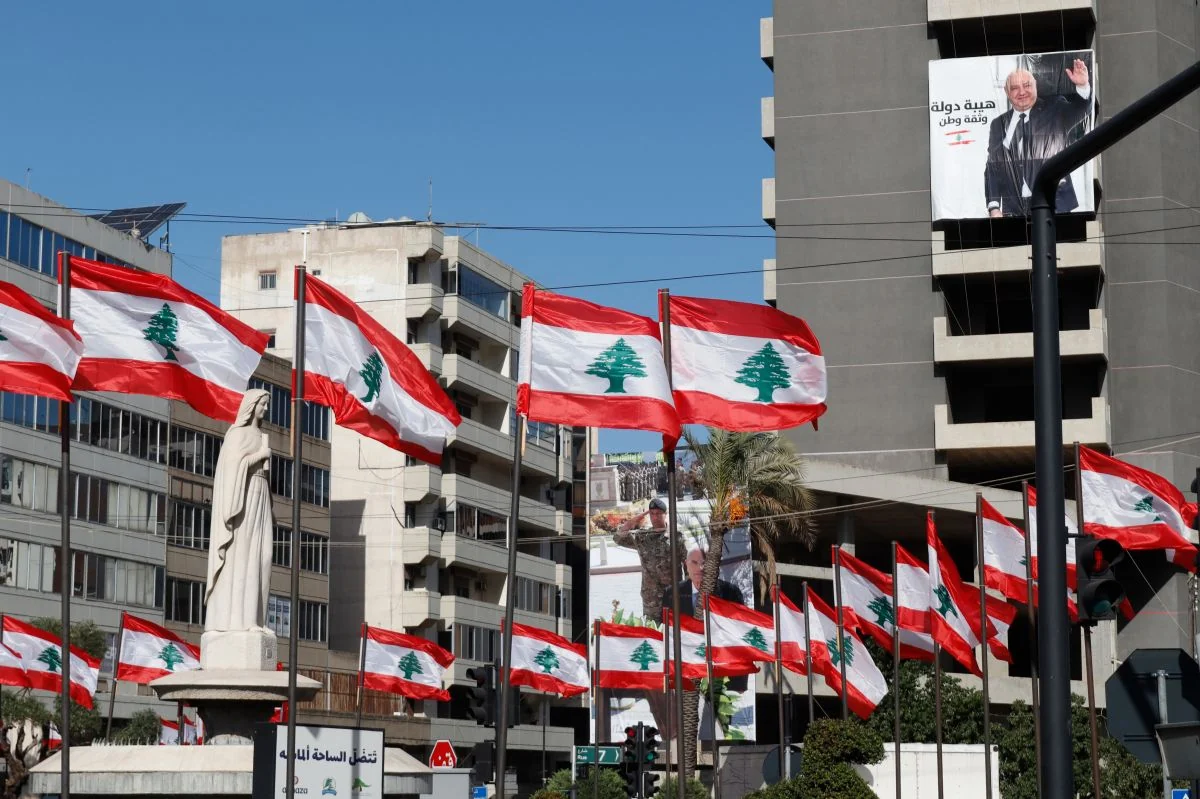
Every November 22, Lebanon celebrates its independence. A lovely day, marked by bold speeches about sovereignty, unity, and the struggle against French rule. Flags are raised, and politicians exchange familiar declarations. Then reality returns: electricity is available only a few hours a day, state institutions are collapsed, or another crisis erupts as the country’s political leaders negotiate over a state that seems to belong more to them than to its people.
By Nadia Ahmad
The French Mandate ended in 1943, but independence and sovereignty were never quite the same thing. Lebanon remained vulnerable to communal bargaining, foreign intervention and elite capture. Eighty-three years later, one question remains: who owns the republic?
The problem is rooted in the political bargain through which the state was constructed. In 1943, Maronite Christian President Bechara El Khoury and Sunni Muslim Prime Minister Riad Al Solh reached the so-called National Pact to establish a sectarian power-sharing system and end the French Mandate.
It distributed the highest offices along communal lines. It reflected the realities of its time and offered a formula for coexistence, but also established a dangerous precedent: the state would be managed through communal representatives rather than equal citizens.
The presidency went to a Maronite Christian, the premiership to a Sunni Muslim and the speakership to a Shia Muslim. Political representation gradually became communal ownership. Citizens approached the state through sectarian intermediaries, while political leaders became brokers between communities and public institutions.
Lebanon's 18 recognised religious communities are not the problem. Religious diversity is part of its history. The problem is a political system that turns diversity into a mechanism for distributing power, public employment, contracts and influence. Political families have learned to present their privileges as protecting entire communities.
The 1989 Taif Agreement ended the civil war, rebalanced political authority and called for the gradual abolition of political confessionalism. Article 95 of the Constitution provides for a transitional plan and a national committee. Yet the transition never became a serious political project. The temporary arrangement survived; its promised destination remained theoretical.
Lebanon emerged from the civil war with institutions restored but without changing the incentives governing them. Reconstruction relied heavily on public borrowing and political networks.
Contracts, appointments and access to resources became instruments of influence. The World Bank has documented how elite capture, patronage and political interference weakened institutions. The state could distribute privileges more reliably than basic services.
The financial collapse of 2019 exposed the consequences. Banks closed their doors, deposits became inaccessible, the Lebanese pound lost most of its value, and ordinary citizens discovered that a lifetime of savings could disappear behind administrative restrictions.
The crisis was not an unavoidable natural disaster. Years of excessive borrowing, unsustainable financial arrangements, weak oversight and political paralysis had created the conditions for collapse. Warnings were available, but the political and financial establishment failed to address the risks.
Financial losses have been estimated at roughly $70 billion or more. Yet who should bear the cost remains unresolved. Depositors have spent years waiting for answers while banks, the central bank and the state dispute responsibility. The IMF continues to demand a credible restructuring framework and a fair distribution of losses.
The political class cannot ask citizens to accept austerity while treating accountability as optional. A country cannot rebuild confidence by asking those who lost their money to finance the rehabilitation of the institutions that failed them.
The same logic applies to debt. Borrowing can finance development when institutions supervise spending and citizens can inspect accounts. In Lebanon, debt too often postponed political decisions, concealed structural weaknesses and shifted costs into the future. That future has arrived, and the bill belongs in public view.
Nor can the crisis be separated from the political economy of instability. The civil war ended in 1990, but the networks that flourished during conflict did not disappear. Armed influence, informal taxation, smuggling, parallel economic channels and patronage have weakened state authority.
The World Bank has documented illicit trade in subsidised fuel, medicines and food, as well as the vulnerability of public procurement and reconstruction contracts to political capture.
This does not mean every businessman, politician or armed organisation operates in the same way; accusations against individuals require evidence. But the pattern is clear: when institutions are weak, those controlling access, protection and resources gain influence.
When borders and laws are not consistently enforced, parallel networks expand. Patronage turns reconstruction money into another instrument of political dependency.
Instability can also create opportunities for political survival. Citizens dependent on political patrons for jobs, healthcare or protection are less able to challenge them. Communities living under constant security anxiety may accept the authority of those claiming to defend them. This does not prove that every actor deliberately creates conflict. It shows how the system rewards those who benefit from dysfunction.
That is the deeper failure of Lebanese independence. The country did not merely struggle to build a functioning state. Its political and economic arrangements repeatedly rewarded the continuation of that failure.
The war economy exacts a price beyond lost income: destroyed homes, damaged infrastructure, displaced families, interrupted education and closed businesses. The state inherits reconstruction costs while citizens rebuild their lives again. The World Bank's August 2026 assessment projected a 6.4 per cent economic contraction after renewed conflict reversed 2025's fragile recovery.
Lebanon cannot treat sovereignty as ceremony while decisions about war and peace are made beyond its constitutional institutions. A republic cannot function when the state lacks authority over the legitimate use of force. This is the foundation of equal citizenship: no Lebanese citizen should live under a security arrangement determined by an organisation or foreign sponsor beyond the state's accountability.
The relationship with Israel is central to this question. For decades, hostility has shaped Lebanon's security environment, strengthened competing political projects and repeatedly exposed Lebanese territory to devastating conflict. The absence of a peace agreement has not protected Lebanon from war; it has left the country vulnerable to confrontation and external calculations.
Direct engagement between Lebanon and Israel in 2026, culminating in the June 26 trilateral framework supported by the United States, created an opening. It set out an ambition to end the state of conflict, establish peaceful relations and restore Lebanese sovereign authority through a reciprocal process.
It did not deliver a comprehensive peace agreement, and major obstacles remain. Still, it showed that direct engagement is possible.
Peace with Israel should not be framed as a favour or a demand that Lebanon abandon legitimate security interests. Its value must be measured by what citizens gain from a stable border and a state able to make its own decisions.
Any durable agreement requires security guarantees, respect for sovereignty, resolution of outstanding issues and restoration of state authority. Lebanon must also prevent its territory from being used to attack its neighbours.
The economic possibilities are significant. A Lebanon no longer consumed by conflict could redirect resources towards reconstruction, tourism, agriculture, technology, energy and trade. Regional transport links, investment and commercial cooperation could become realistic policy goals.
A peaceful Levant would create opportunities for Lebanese businesses and workers while reducing the cost of permanent insecurity. Peace cannot replace domestic reform, but continued hostility offers no path to development.
Lebanon can remain a battleground for competing powers, or become a country whose government determines foreign policy according to national interests. It can depend on external patrons, or build institutions capable of negotiating with neighbours from a position of sovereignty. Peace does not require forgetting history; it requires refusing to make the next generation pay for the conflicts of the previous one.
The answer begins at home. Article 95 must become a constitutional commitment, not an abandoned promise. Public appointments must be based on competence, procurement must be transparent, and the judiciary must be independent.
Banks must be restructured fairly, depositors given a credible path to recovery, and financial misconduct investigated. The army and legitimate security institutions must exercise authority throughout the country. These are the minimum conditions of a functioning republic.
Lebanon need not erase its religious communities, historical differences or cultural identities. It must stop allowing political representatives to claim ownership of citizens because of those identities.
Every Christian, Sunni, Shia, Druze and other citizen should encounter the same state, enjoy equal legal protection and demand equal accountability.
Independence is not a date that can be celebrated indefinitely while its substance remains unfinished. The French Mandate ended in 1943. The civil war ended in 1990. Yet the struggle to establish a state answerable to its citizens continues.
Lebanon's next independence will not be achieved through another declaration, another political bargain or another distribution of offices. It will begin when the republic belongs to its citizens rather than to the networks that manage them.
A country cannot remain sovereign when its institutions are captured, its economy is hostage to political arrangements, and its security is determined by competing powers. Nor can it expect prosperity while treating peace with its neighbours as an impossible subject.
Lebanon has spent decades waiting for its political leaders to deliver the country promised in 1943. Perhaps it is time to reverse the relationship. The citizens must demand a state worthy of their independence, rather than wait for the people who benefit from its incompleteness to grant it.