There are cities we grow up hearing about, cities we encounter in history books, and cities we eventually get to explore for ourselves. For me, Damascus had long belonged to the first two categories until November 2026, when I finally had the chance to experience the Syrian capital with my husband.
Syria was not entirely unfamiliar to me. I had visited Masyaf when I was seven, passed through Tartous and Damascus airport during the 2006 war in Lebanon, and travelled to Aleppo in 2009. However, despite these previous visits, I had never properly explored Damascus.
As someone who has loved history since childhood, visiting one of the world’s oldest continuously inhabited cities was an opportunity to experience what I had previously encountered through books.
Walking through centuries of history
Recognised as a UNESCO World Heritage Site since 1979, the Old City of Damascus carries the architectural and cultural traces of numerous civilisations, from the Aramaeans and Romans to the Byzantines, Umayyads and Ottomans.
Among the places I explored was Bab Touma, the Gate of Thomas, an entrance to the city’s historic Christian quarter, where narrow streets, traditional buildings, churches and cafés coexist.
Bab Sharqi was also on the list. It is the eastern gate of the Old City, connecting to the famous Straight Street mentioned in the Acts of the Apostles in connection with the conversion of Saint Paul.
My exploration continued through Souk Al-Hamidiyah, one of Damascus’s most recognisable traditional markets, with shops selling spices, sweets, textiles and traditional crafts. Having studied fashion design, I have always found such markets fascinating, as craftsmanship can reveal just as much about a civilisation as its monuments.
I also explored Al-Qaymariyya, known for its traditional Damascene houses and narrow alleyways, and Al-Nawfara, home to a historic coffeehouse associated with the hakawati tradition. This storyteller entertains audiences with tales drawn from history and folklore.
As a writer, I find it fascinating how storytelling once brought entire communities together in coffeehouses, long before modern forms of entertainment existed.
The Umayyad Mosque and Al-Azm Palace
Among the most significant landmarks I visited was the Umayyad Mosque, also known as the Great Mosque of Damascus, an eighth-century architectural masterpiece.
The site once housed a Roman temple and subsequently a Christian basilica before becoming a mosque. It also contains a shrine traditionally believed to hold the head of Saint John the Baptist, a figure revered in both Christianity and Islam.
Another remarkable landmark was Al-Azm Palace, an eighteenth-century Ottoman-era residence built for As’ad Pasha al-Azm, then governor of Damascus. Its interior courtyards, fountains, intricate stonework and decorative details illustrate the beauty of traditional Damascene architecture, where relatively modest façades often conceal elaborate interior spaces.
Beyond the walls of Old Damascus
My visit was not limited to the Old City. I also explored Abu Rummaneh, with its residential buildings, embassies, and tree-lined streets; Al-Muhajirin, situated along the slopes of Mount Qasioun; and the boulevard near the Four Seasons Hotel.
These areas introduced me to a more contemporary side of Damascus, offering a different perspective on a capital often celebrated primarily for its ancient heritage.
Beyond Damascus: Saydnaya and Maaloula
The visit included Saydnaya and Maaloula, two destinations of particular significance within Syria’s Christian heritage. Saydnaya is home to the historic Greek Orthodox Monastery of Our Lady, whose foundation is traditionally attributed to Byzantine Emperor Justinian I in the sixth century.
Maaloula, meanwhile, is renowned for its monasteries, mountainous landscape and linguistic heritage, with some inhabitants continuing to speak Western Neo-Aramaic, a modern descendant of Aramaic, the language spoken by Jesus Christ.
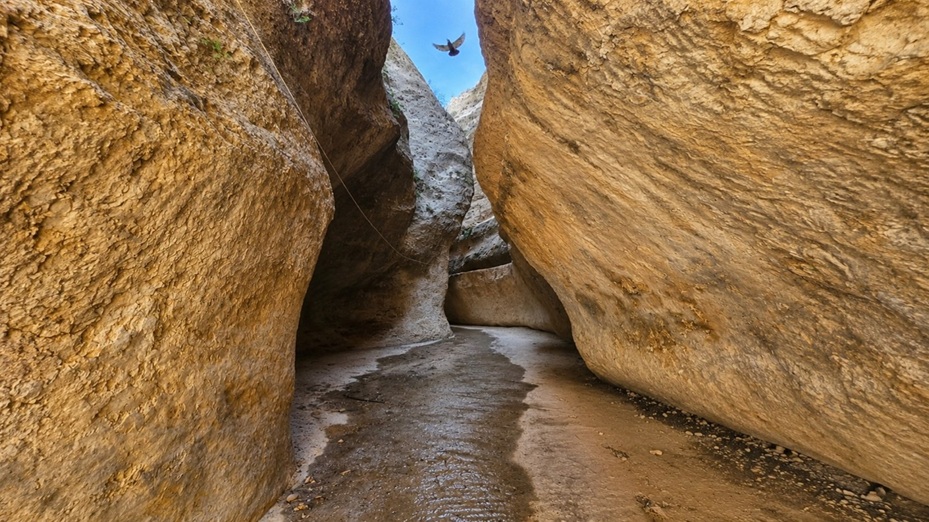
Having studied translation and interpreting, visiting a place associated with the survival of such an ancient linguistic tradition carried particular significance for me. One of the most fascinating sites I visited was the rocky passage of Saint Thecla, known locally as Fajj Mar Taqla. According to Christian tradition, the mountain miraculously opened to shelter the saint as she fled persecution.
Walking between the towering rock formations, I even managed to photograph a bird flying through the narrow opening above, a beautiful detail that made the moment particularly memorable.
A country beyond its headlines
While international coverage of Syria has understandably focused on conflict and displacement, the country’s identity also encompasses centuries of religious heritage, literature, architecture and craftsmanship.
When I returned to Dubai in mid-November, I brought back photographs, memories, and a deeper appreciation of Syria’s cultural and historical richness.
There is still so much of the country I have yet to explore. Still, perhaps the most beautiful part of travelling, especially for someone who grew up fascinated by history, is finally finding yourself standing in the very places you once only read about.