Some bilateral state relations forged centuries ago are a blessing, while others become a paradox for the state. Armenia is one such state that is carefully navigating its relations with Russia at a turning point in its foreign policy, as the dichotomy between the two deepens. From that perspective, the June 7 elections in Armenia were a turning point in its political history, particularly in determining the fate of its foreign policy and the geopolitics of the South Caucasus.
By Ahsan Ali
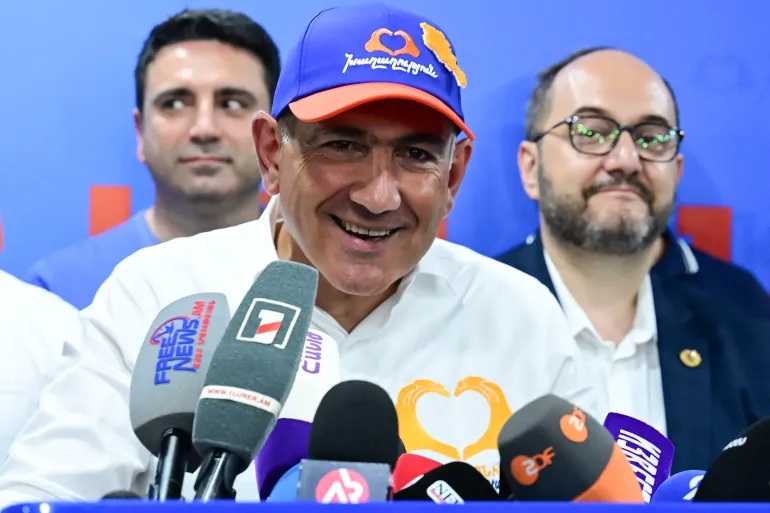
Armenia’s ruling pro-Europe party has won parliamentary elections, confirming the country’s pivot towards the European Union (EU) and the United States, away from its traditional ally, Russia.
Final results in the small South Caucasus country showed that the prime minister, Nikol Pashinyan’s Civil Contract party secured a slim majority. At the same time, the Strong Armenia alliance, led by the Russian-Armenian billionaire Samvel Karapetyan, won 25% of the seats in parliament.
The premiership of Pashinyan has emerged as a turning point in Armenia's history, with efforts to diversify ties through strategic partnerships with the EU, the US, and India. His further normalisation efforts with Turkey and Azerbaijan have laid the foundations for changing the geopolitics of the South Caucasus and Anatolia.
Pashinyan’s reconciliation with Azerbaijan has been widely acknowledged by the Azerbaijani leadership, with even endorsement from President Trump. The broader stabilisation efforts have been welcomed across the board by various actors, with the EU expressing renewed hope for European-style democracy in the South Caucasus after failed efforts in Georgia.
Pashinyan's orientation towards the EU and Washington came at the expense of Moscow. The redirection is not supported in Russia, and there are warnings of the continued progress in relations between Yerevan and Brussels.
Armenia under Pashinyan has significantly shifted course, reinvigorated integration in the South Caucasus, and pursued closer ties with the EU. There have been indirect threats towards Armenia, especially via political statements, suspension of economic relations, and cessation of discounted gas to Armenia, a scenario familiar to Ukraine back in 2014.
Russia’s influence in Armenia is structural and indirect, rather than overt electoral interference, and is based on energy infrastructural linkage, economic dependencies, and security relations. The political messaging within the media ecosystem aligns the population with the political party's strategic preferences to gain traction during electoral cycles.
The May 2026 Eurasian Economic Union (EAEU) meeting in Astana issued a statement calling for a referendum on whether to stay in the Russian-led EAEU or move closer toward the EU. The Armenian economy currently relies on 14% of its GDP through the EAEU partnership, and any expulsion in the current scenario could be costly.
Russia's threat to expel Armenia from the EAEU can be seen as one of its tactics to make Yerevan rethink its foreign policy. Meanwhile, Russia has already put Armenian exports under a barrage of restrictions in recent weeks. The restrictions come at a pivotal moment as Armenia heads towards elections and come with a message to vote methodically.
Beyond economic leverage, Russia retained political influence, as most Armenian opposition supports strong relations with Russia. Among the political challengers is Armenian-Russian billionaire Karapetyan, who advocates for stronger ties with Russia and has alleged links with Russian intelligence.
Simultaneously, political figures Robert Kocharyan (almost 10 per cent of the vote) and Gagik Tsarukyan (4 per cent) have been alleged to have similar links to the Kremlin, which endorses closer ties with Russia. The discreet support for the opposition is aimed at preserving Russia's influence in Armenia, in line with its traditional foreign policy of maintaining the previous status quo and security ties with Moscow.
After Moldova, Russia is attempting to sow the seeds of division to destabilise the political course in Armenia, which wants to end a one-vector foreign policy. Russia is leveraging disinformation channels and backing pro-Russian candidates to retain influence in the domestic political arena.
Sunday’s elections were strategically important, as the bilateral ties between Azerbaijan and Armenia, including with Russia, depend on these elections. While Armenia, under Premier Nikol Pashinyan, has progressed towards peace with Azerbaijan and Turkey, there are ruptures within the state that seek to end the official peace negotiations.
Where Russian influence is waning, the US-sponsored TRIPP route challenges it and converges in the former Soviet republic. This connectivity route reflects the broader architecture of an increasing US presence in Russia's backyard and a more contested regional order.
As Armenia aligns itself with the EU, the 8th European Political Summit on 4th May reflects deepened political and strategic ties. The summit sends a strategic signal of long-term alignment and connectivity. The EU leaders' endorsement of Premier Pashinyan reflects an indirect projection of joining and a long-term trajectory towards Armenia-EU convergence.
The Constitutional amendment referenced in the Armenia-Azerbaijan peace framework is widely viewed as critical, though politically sensitive for long-term peace efforts. In this context, Prime Minister Pashinyan’s government is seen as the principal actor in advancing such reforms and enabling the region to undergo post-conflict development.
Concurrently, Armenian foreign policy orientation is on reconfiguring the economic and infrastructural reintegration with regional connectivity in the South Caucasus. The dynamics reconfigure Armenia's strategic positioning in projects involving Turkey, Azerbaijan, and Georgia, thereby establishing interdependence and stabilisation.
From the Armenian Apostolic Church to pro-Kremlin opposition political figures, who want the current geopolitical paradigm to change permanently. If any pro-Russian leader emerges in the elections, it could meaningfully reshape Armenia's foreign policy trajectory and affect peace dynamics between Armenia and Azerbaijan, subject to institutional and geopolitical constraints.
Historically, Russia’s role in the post-Soviet space has been marked by sustained efforts to preserve political and strategic influence. It can be observed that the unresolved conflicts of Georgia and Ukraine continue to shape security dynamics. In Armenia, the presence of Russian troops is often cited as challenging strategic autonomy, and “once Russians are in your house, it’s sometimes very difficult to get them to leave.”
If the June 7 elections illustrate one thing, it is the crossroads in the evolving Armenian political trajectory, with potential implications for foreign policy orientation and domestic institutional balance. It can be viewed in light of competing external influences from Russia that would change the geopolitical landscape and the broader South Caucasus as a whole.