By Layla Azmi Goushey

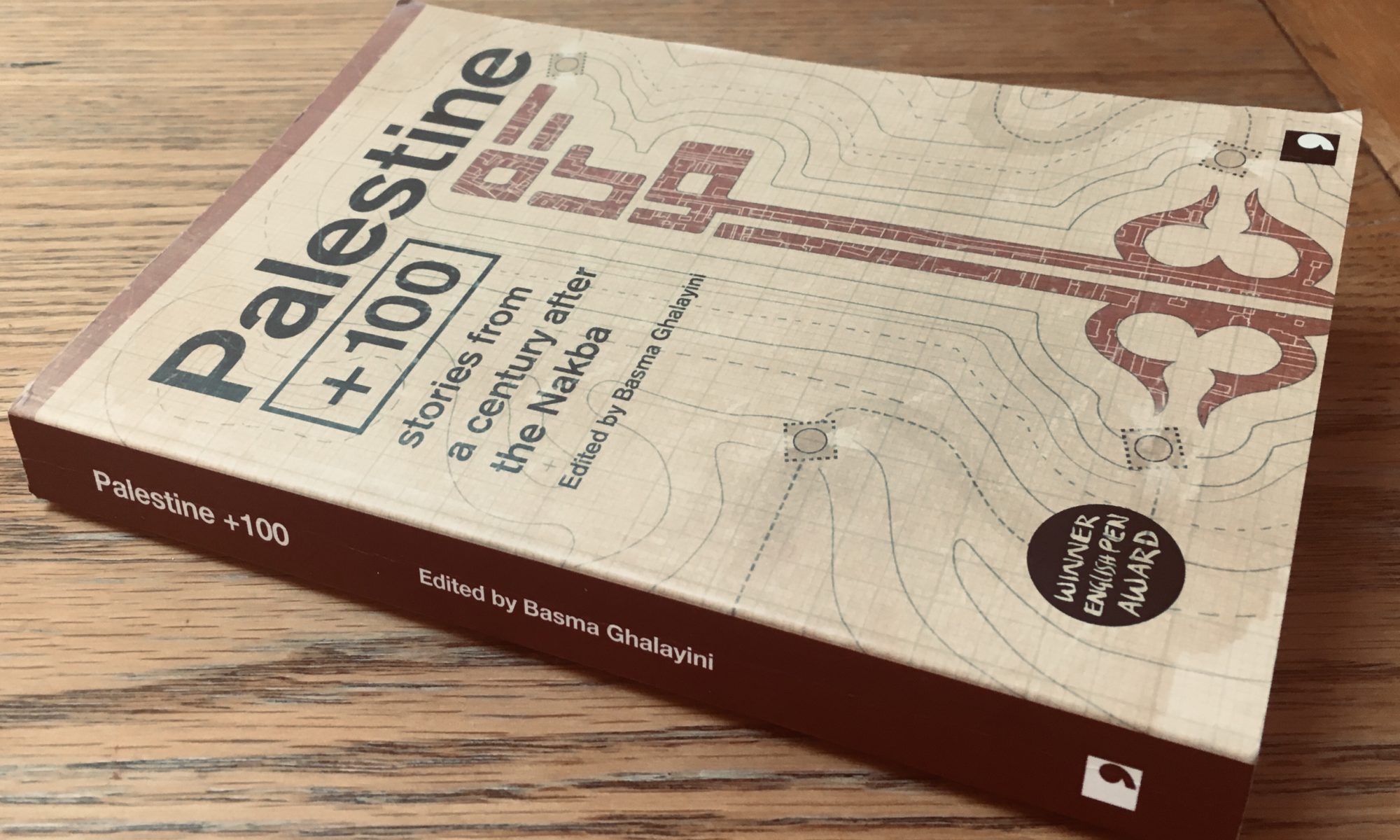
In Palestine + 100: Stories from a century after the Nakba, twelve Palestinian writers answer the question” What might your country look like in the year 2048?” Their answers are encased in a thrilling collection of speculative, dystopian, and futuristic short fiction edited by Basma Ghalayini. All stories are in English. Some have been translated from the original Arabic.
Every story in Palestine + 100 is a gem that evokes feelings of suspense, excitement, horror, and nostalgia. While reading, I was absorbed by surprising insights and discoveries. I could hardly put down the book and I am still reflecting on its important themes.
Saleem Haddad’s “Song of the Birds” offers an existential look at personal realities for Gazans in 2048. His writing is so exquisite that I literally gasped at the protagonist’s gritty experience of finding herself engulfed in a nauseating situation. The story’s end prompts us to ponder our own perceptions of freedom and truth.
The fascinating world-building of Emad El-Din Aysha in “Digital Nation” is accomplished through artful dialogue and aspects of the plot that invite us to consider how virtual realities can be used and misused depending on the hacker who influences the system.
In “Sleep it Off, Dr. Schott,” Selma Dabbagh prompts intense reflections on concepts of privacy, national security, personal interests, and human motivations. The protagonist, Layla Wattan, whose great grandparents are from Haifa, is a Recorder from the Secular Scientific Enclave of Gaza in 2048. Her job is to secretly videotape individuals in compromising settings.
Writers in Palestine + 100 show us how the nostalgia of one culture or generation can become the ghost of another, that emerging technologies may be used to create virtual realities where people are kept calm and caged, and that living under oppression can cause us to question reality.
I am a long-time science fiction and fantasy fan, and as a youngster in America most of my reading choices were from the works of Ray Bradbury, Ursula K. Le Guin, and Isaac Asimov along with many mass market paper backs of emerging science fiction writers. The lack of Arabic fiction accessible to me as a Palestinian-American reader of English was limited and there were no opportunities to read speculative, futuristic Arabic fiction. Part of this is because of lack of demand for translated texts in the 1970s and 1980s, but such speculative stories were limited in Arabic as well. As Basma Ghalayini notes in the “Introduction” to Palestine + 100, Palestinians feel a cultural duty, an obligation, to relate the trauma of the Nakba. Until recently, by focusing on the past and trying to bring attention to the “cruel present,” Palestinians did not have time to write futuristic stories.
However, as Ghalayini also explains, science fiction can “offer surprising opportunities” for exploring the complexities of the Palestinian diaspora and emerging Palestinian writers are embracing the speculative fiction genre.
Ghalayini states, “The actual future is unknowable” but science fiction, speculative fiction, “is a license to re-imagine, re-configure, and -re-interrogate the present.” Readers of Palestine + 100 will discover compelling realms of Palestinian imagination while also learning about the cruelties of the present. The injustices and brutalities depicted in this volume are framed in futuristic terms, but they are also rooted in the grim foundations of past and present-day Palestine.
The high-quality writing in this volume is a treat. The talented writers of Palestine 100 have created futuristic stories with emotional and intellectual resonance.
A link to more information about Palestine + 100 and its authors can be found here.