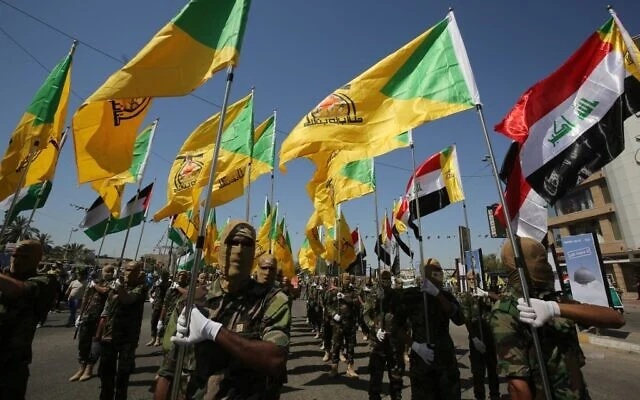
Iran's proxy network did not emerge by accident — it was built over decades to absorb precisely the kind of blows it is receiving today.
What is unfolding today in the Middle East cannot be read in isolation from what preceded it. Iran was not caught off guard by this war: it had been preparing since last summer, when strikes began to accumulate against its territory and immediate environment. Hamas's attack on October 7, 2023, marked a pivotal turning point, followed by simultaneous escalation across multiple fronts: Lebanese Hezbollah, Iranian-backed factions in Iraq, and the Houthis in Yemen.
By Hiba Abdulwahhab
That synchronisation was not spontaneous. A careful reading of the landscape reveals a precise coordination structure that transcends the traditional concept of a "proxy" toward something closer to a unified body driven by a single central nerve.
Yet for the discerning observer, there is a strategically significant pattern: Iran deploys its proxies sequentially rather than simultaneously. In the first phase, Hezbollah and the Houthis carried the greatest momentum while the Iraqi factions operated in the shadows.
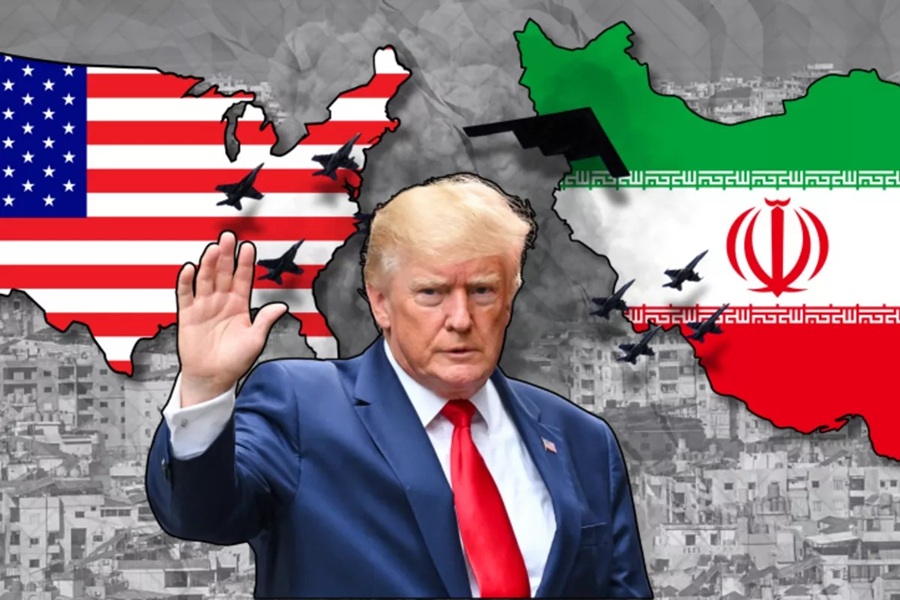
Today, as the war is being fought within Iranian geography itself, Iran has made Iraq a frontline since the United States and Israel launched strikes on February 28. Tehran is using Iraqi militias to target American bases in Iraq and beyond, striking vital areas in an ongoing escalation that risks pulling the country into a conflagration it is structurally unprepared to withstand.
Roots beyond borders: Iran plants what keeps it alive
There is a fundamental paradox governing this war: inside its borders, Iran is waging an existential, zero-sum struggle — yet outside those borders, it relies on deep-rooted foundations cultivated over decades, far beyond the reach of any airstrike.
Iran has spent decades building a vast network of proxies across the region, a project in which it has succeeded considerably — placing the Arab world under sustained pressure and confronting regional political orders with crises so acute that no one can predict whether they will emerge from them intact.
This presence is not accidental. Since the U.S. invasion of Iraq in 2003, Iran pursued a dual-track strategy: embedding a loyalist government by integrating the Dawa Party, the Supreme Council, and the Badr Organisation into the new political system, while simultaneously sponsoring armed resistance through existing militias and newly created factions such as Kata'ib Hezbollah and Asa'ib Ahl al-Haq.
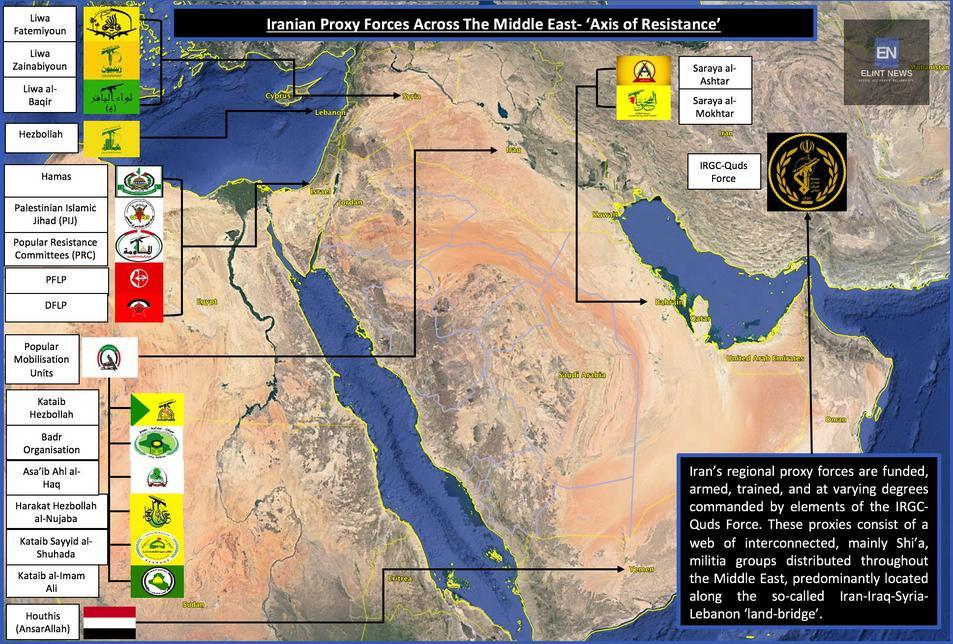
This network is precisely what makes dismantling Iranian influence so extraordinarily complex. Targeting Tehran alone is insufficient without severing the deep roots embedded across the region and eliminating the conditions that enabled their growth.
Cutting the head does not stop the body: The killing of Hassan Nasrallah
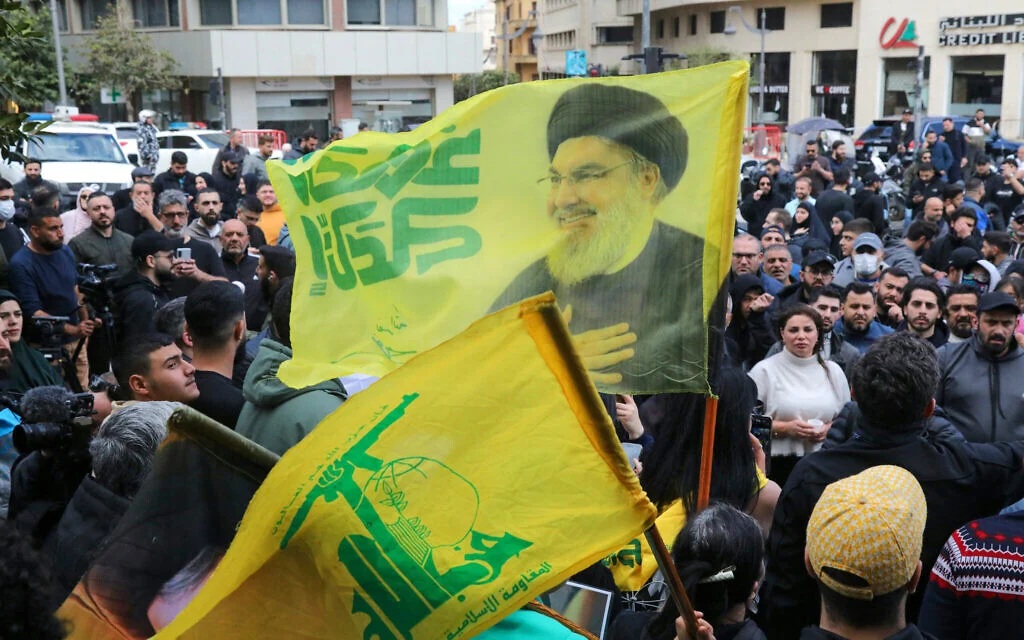
On September 27, 2024, Israel achieved what it had long pursued — the assassination of Hassan Nasrallah, Hezbollah's Secretary-General for thirty-two years, in an airstrike that destroyed an underground command centre in Beirut's southern suburb using more than eighty munitions. The event was consequential by any measure — it eliminated not merely a symbol, but the strategic and military architect who transformed Hezbollah into a regional power on Iran's behalf.
Yet history offers a sobering lesson: targeted killings are necessary to win battles, but they are not sufficient to win wars. Israel assassinated Hezbollah's military commander Imad Mughniyeh in 2008, and the organisation grew stronger in the years that followed. It similarly eliminated Hamas founder Sheikh Ahmed Yassin, yet the movement did not collapse and continued its activities until October 2023.
Hezbollah, in its third phase, will be more volatile and constrained in the short and medium term — its leadership is degraded, its resources depleted, and its operational bureaucracy disrupted. But the organisation will not collapse imminently. It retains hundreds of thousands of fighters and a substantial missile arsenal.
Iran has already dispatched additional Islamic Revolutionary Guard Corps (IRGC) officers to Lebanon to fill the leadership vacuum and restructure from within. The body did not die when its head was removed — it is in the process of reconstituting itself.
The fall of Assad: Severing the vein, not the artery
The world had barely absorbed the shock of Nasrallah's killing when another significant blow struck Tehran: the fall of Bashar al-Assad's regime on December 8, 2024, and the rapid collapse of decades of Iranian investment in Syria. Iran lost a critical strategic base and a primary supply corridor to Hezbollah. With its collapse, what had long been described as the 'Shia Crescent.'
President Ahmad al-Sharaa assumed leadership of the transitional phase, declaring from the outset an unambiguous position on Iranian presence. Al-Sharaa stated that the Syrian opposition had "set back Iran's regional project by forty years," affirming that expelling Iranian militias and closing Syria to their influence had achieved what years of diplomacy and external pressure could not. He described in multiple interviews Iran's legacy in Syria as a "deep wound."
The self-proclaimed Syrian leader conditioned any resumption of relations on a complete halt to interference in internal affairs and an end to sectarian incitement. Iran's logistical corridor to Hezbollah has been dismantled, and Russia now risks losing its military foothold in Syria.
Yet caution is warranted against premature declarations of finality. Iran may seek to consolidate ties with more radical factions or sponsor alternative insurgencies to compensate for its lost Syrian foothold — precisely as it backed Hamas as an alternative to the Palestinian Authority. Most consequentially, the loss of Syria did not end Iran's regional ambitions; it redirected them toward Iraq with greater urgency than at any previous moment.
Iraq and a cluster of crises
Iraq deserves particular analytical attention — not as a peripheral front, but as the pivot around which the conflict now turns. The central problem is that Iraq entered this phase bearing the weight of structural fragility at its most acute. On the political front, the November 2025 elections produced a deeply fragmented landscape.
Al-Sudani's Construction and Development Coalition won only 46 of 329 parliamentary seats, meaning Iraq faces a prolonged period of exhausting political negotiations before a new government can form — a pattern replicated in 2010 and 2021. In this vacuum, the Sudani government remains in caretaker status, stripped of effective decision-making authority precisely when it is most needed.
The dynamics within the Shia political house are no less complex. Nouri al-Maliki has a well-documented pattern of nominating a "controllable" prime minister and then systematically weakening him, as he did with al-Abadi, and appears to have repeated with al-Sudani.
Meanwhile, Asa'ib Ahl al-Haq, under Qais al-Khazali, simultaneously wields military, economic, and political influence — its affiliated movement, al-Sadiqoun, secured twenty-seven seats in the latest elections. The Sadrist movement, despite its electoral absence, remains a significant reserve force capable of reshaping any governmental equation. Compounding this is the chronic fragility of Sunni political representation, whose absence from the centre of power has only deepened during this critical juncture.
A state within the state: The PMF and its reach
At the heart of this landscape lies an inescapable structural reality: there exists in Iraq a force that rivals state institutions in size and surpasses them in practical influence. The Popular Mobilisation Forces (PMF) comprise approximately 230,000 fighters organised into 67 factions, many of which operate with effective independence from formal military command.
They control substantial sectors of the Iraqi economy through affiliated commercial entities, and exercise significant influence over state institutions through their political arms embedded within the Coordination Framework.
These factions do not stand outside the state — they inhabit it from within. Since 2014, Iranian-aligned actors have progressively expanded their influence over Iraqi state institutions through non-military mechanisms: institutional capture and the exploitation of legal frameworks.
In the 2018 elections, Asa'ib won 15 parliamentary seats and, alongside Badr and al-Maliki, supported the formation of the Abd al-Mahdi government, which in turn facilitated further militia expansion. The number of seats directly linked to armed factions in the current parliament exceeds sixty-six — more than a third of the ruling bloc.
This is not incidental infiltration but a systematic strategy for capturing the arteries of the state from within. That strategy has extended even to the banking sector: Iraqi bank officials have exploited their positions to channel resources to the IRGC, Kata'ib Hezbollah, and Asa'ib Ahl al-Haq, granting the Revolutionary Guard a degree of control over supervised financial institutions.
Programmed resilience
A comprehensive reading of this landscape reveals a central truth: focusing on Iran's vulnerabilities is no longer sufficient to understand its behaviour. Those vulnerabilities are now exposed and well-documented. What demands attention, rather, are the centres of power that have enabled Iran to persist and reconstitute itself despite sustained military pressure.
Iran built its regional project on the principle of replication and compensation. When Nasrallah fell, the IRGC moved to fill the void. When Assad fell, the stakes in Iraq intensified. When Tehran is struck from within, the Iraqi factions advance as the operational spearhead — and the same rhythm echoes in the Houthi factions in Yemen. This is not fragility; it is programmed resilience embedded within the very architecture of the project.
More dangerously, this power is not limited to proxy management — it extends to behaviours that span state borders and go beyond conventional deterrence.
Iran conducts systematic patterns of hostile activity: targeting Gulf states and their energy infrastructure, exploiting its tools to disrupt international navigation, and — as we witness today — using what amounts to organised maritime coercion in the Strait of Hormuz as a sustained instrument of pressure and leverage.
Iran did not merely build influence inside states; it imposed a formula based on exporting instability and creating permanent pressure points throughout its regional environment. This behaviour, entrenched over decades, will not be dismantled by a single military campaign, however intense.
Accordingly, understanding this architecture, with clear-eyed focus on the centres of power that sustain it, is the first prerequisite for any strategy seeking to confront this project and sever its operational arteries. This remains what decision-makers in Washington and beyond are still working to fully internalise, amid the noise of ongoing battles and the accelerating pace of events.