
Giving Feedback is Essential to Grow

Giving feedback is essential to career growth if given constructively and at the right time. The time we wait to deliver the input will directly affect its impact and subsequently reduce its positive outcome to help boost our career growth.

By Emile Fakhoury
Feedback should be given at regular phases during the year and can be given to yourself, your managers, and your peers.

There are four types of feedback:

  • Negative feedback – corrective comments about past performance.
  • Positive feedback – affirming comments about past performance.
  • Negative feedback – corrective comments about future performance.
  • Positive feedback – affirming comments about future performance.

The best feedback is constructive feedback balanced between negative and positive and given on time and regularly to impact career growth.
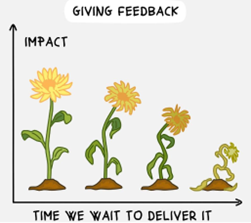
Also, feedback could come from various sources:

  • Self-feedback is assessing yourself based on your observations and reflections. This can help you track your progress, identify gaps, and set goals.
  • Peer feedback occurs when you exchange advice with those in similar roles or functions. This can help you learn from each other, share best practices, and solve problems together.
  • Manager feedback is when you receive or give feedback to your direct supervisor or manager. This can help you understand your performance, expectations, and development needs.
  • Client feedback is when you receive or give feedback to external or internal customers who use your products or services.

The challenges of feedback are evident. It can present a few difficulties to your career development, such as bias, inconsistency, or feeling overwhelmed. It may also be dismissed or defended.

To mitigate these issues, you should have a feedback mindset that views it as a learning experience rather than an assessment or a danger. This way, you can make the most of the feedback you receive and use it to your advantage.

You should also carefully select the sources and people who provide you feedback so you don’t get too much negative or positive feedback. Mix non-biased input sources from peers, reports, and managers in various roles and businesses. Hence, you are sure you are not focused on a particular group that will provide identical feedback.

The skills of feedback:

Feedback is a skill that can be developed with practice and training or coaching. Listening, asking, giving, receiving, and acting are the critical skills of feedback.

  • Listening involves paying attention to understand the feedback message.
  • Asking involves seeking, inviting, and clarifying feedback.
  • Giving involves providing, delivering, and supporting feedback.
  • Receiving involves accepting, acknowledging, and appreciating feedback.
  • Acting involves applying, implementing, and following up on feedback.

These skills can help you avoid misunderstandings, communicate effectively and respectfully, offer solutions and resources, demonstrate openness, express feelings and concerns, show commitment and accountability, measure results and progress, and show improvement.

One learns a lot from giving and receiving feedback. Both giving and receiving feedback are helpful for career growth. One must be able to take advantage of each opportunity to ask and clarify feedback to ensure we can apply and implement it and follow it up so we can benefit from it.

The strategies of feedback:

Feedback is an essential process for career development. It can help you grow, improve, and succeed in your current and future roles if given at the right time. Planning and preparing for feedback is essential to making it a rewarding experience.

Some feedback strategies include setting goals, choosing sources, scheduling sessions, preparing content, engaging in conversations, and reviewing outcomes.

  • Setting feedback goals can help focus, prioritize, and align efforts.
  • Choosing sources can broaden and enrich perspectives.
  • Scheduling sessions can create a feedback routine.
  • Preparing content can structure and summarize messages.
  • Engaging in conversations can exchange and explore information.
  • Reviewing outcomes can assess results and celebrate successes.

You can maximize the process by developing your feedback skills and strategies.

This process should be repeated at least every six months to compare your performance and progress with the feedback session outcomes. It requires your willingness to improve and implement the feedback outcome and should be done promptly to ensure the best results are achieved.


 

Emile Fakhoury

Corporate Expert Writer, Business Professional in Energy/Water/Oil/Gas, Specialist in Coaching/Training, Association of Project Management UK Fellow Member. The professional who believes that adaptation to various social or corporate environments is the only way to survive and strive. Master the rules of the game in order to reach the top and change the rules.
See full bio >
The Liberum runs on your donation. Fight with us for a free society.
Donation Form (#6)

More articles you might like

The instrumentalisation of the former conflict by the Armenian government in the upcoming election risks the peace process

The dynamics between Armenia and Azerbaijan since the end of the Second Karabakh War have […]

Thank you, even for this

Gratitude is beautiful when life is beautiful, when things arrive on time, when prayers are […]
- by The Liberum on 23/04/2026

European energy policy is accelerating towards the wall

What do you do when you realise you are heading in the wrong direction? Hit […]

The holy democracy and its chosen mediocrity

Some quotes belong on a decorative tile. Others should be carved into the walls of […]
- by Nadia Ahmad on 21/04/2026

The Strait that thinks: Hormuz and the Strait of Peace

There are places on Earth that behave less like geography and more like thought. The […]
A detail from “Narcissus” 1598–1599, by Caravaggio. Oil on Canvas; 43.3 inches by 36.2 inches. National Gallery of Ancient Art, Rome.

Born in a narcissistic family system: The scapegoat doesn’t create the instability, but makes it visible

Usually, a child of narcissistic parents doesn’t experience themselves as adapting. There are a few […]