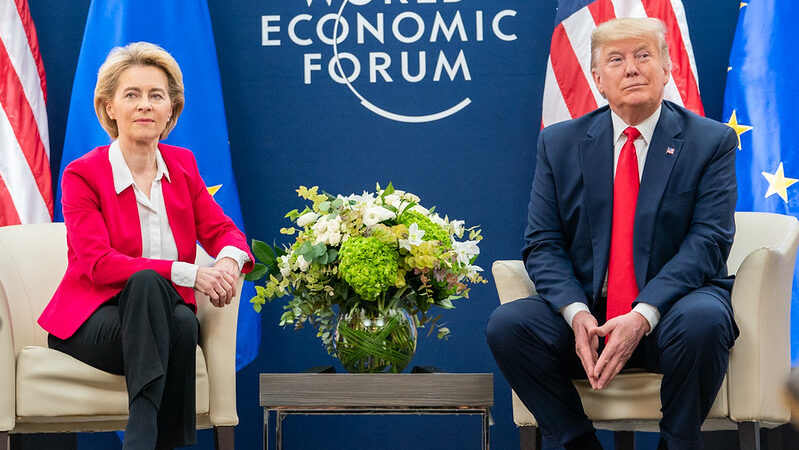
There’s still a widespread illusion that the world order is divided between clashing superpowers, political ideologies, and democracies versus autocracies. But those who look beyond the façades see something far more fundamental: convergence.
By Max von Kreyfelt
While Trump is building an all-encompassing surveillance system with Palantir in the U.S., the European Union is silently constructing an equally ambitious and equally totalitarian control model, cloaked in the language of ‘digital progress’ and ‘public safety’.
Two systems. Two political cultures. However, one logic is that the human being is a data package, and the citizen is a risk profile.
In the U.S., Trump is constructing what he once called ‘the deep state’, only now under his command. What began as populist resistance against elite control ends in a system that makes Orwell look like a moderate.
Palantir, the controversial data-mining company with roots in military operations, is gaining access to all state data, from medical to mobile, from fiscal to social. The goal? Monitor everything. Predict everything. Control everything.
In Europe, the approach is more subtle, but no less dangerous. The EU is developing a digital identity that is linked to your banking information, vaccination status, travel history, and carbon footprint. The entire project is sold as “personalised service” – but in reality, it forms the basis for a social credit system that digitises and marginalises all deviations.
Where Trump centralises data under the flag of patriotism, the EU does so in the name of sustainability and health. However, don’t be misled by the packaging: the system remains the same.
This isn’t about technology, it’s about power. It’s not about efficiency, it’s about obedience. And it’s no longer about left versus right, but about human autonomy versus technocratic control. The political stage has become a distraction. Behind the scenes, the infrastructure of a new order is being built, one where privacy dissolves, choice becomes illusion, and control becomes the norm.
We are entering an era where freedoms are not revoked, but algorithmically rationed. Where deviant behaviour is not punished, but made impossible. No fines. No prison. Just exclusion.
The question is no longer if this is happening.
The question is: what will we do once the system begins to select us?